 Private patient care since 2005
Eye surgery in Turkey
Which operation suits you is decided by measurements, not by preference: corneal thickness, your prescription and your age rule options in and out before anyone discusses price.
People arrive asking for laser surgery and leave having been told that a lens is the right answer, or the other way round. Both are correct answers to different eyes. A thin cornea rules out some laser techniques; a prescription beyond a certain strength rules out laser altogether; past your mid-forties, laser on its own will not deal with reading vision.
None of that can be settled from an enquiry form. What it means in practice is that any firm quotation given before your eyes have been measured is provisional, and we will say so rather than pretend otherwise.
Not wanting glasses any more
Reshaping the cornea. Suitable for a defined range of prescriptions and a cornea thick enough to allow it.
- Laser eye surgeryThe cornea is reshaped with a laser to correct short sight, long sight and astigmatism.
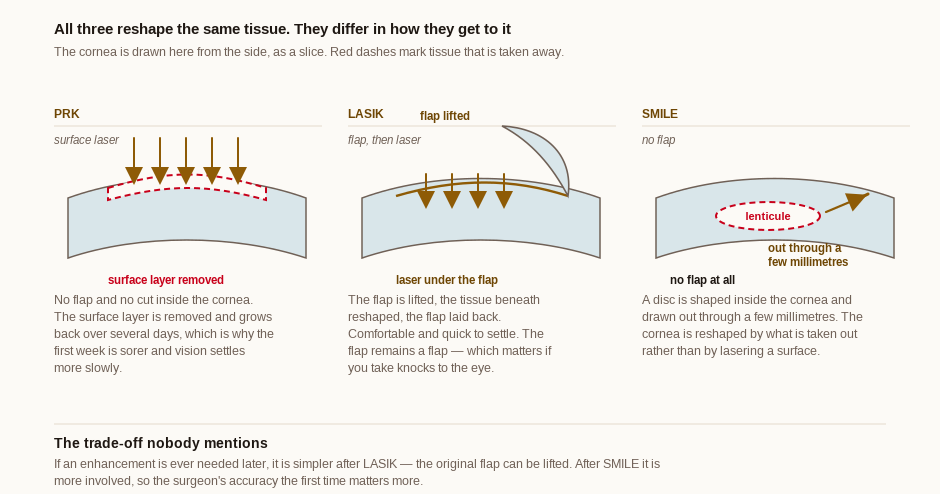
- SMILE laser surgeryNo flap is made at all. Less dry eye and nothing to displace — against a narrower range and a more involved enhancement later.
We also arrange LASIK and bladeless iLASIK, PRK for a thinner cornea or contact sports, and ICL, where a permanent lens is placed in front of your own for prescriptions too strong for laser. There is no separate page for these yet — ask and a surgeon will tell you whether it applies to you.
When the lens itself is the problem
Your natural lens is removed and an artificial one takes its place. The same operation as cataract surgery — the difference is whether a cataract has formed yet.
- Lens replacement surgeryWhich lens, what it corrects and what it costs you at night — the choice explained.
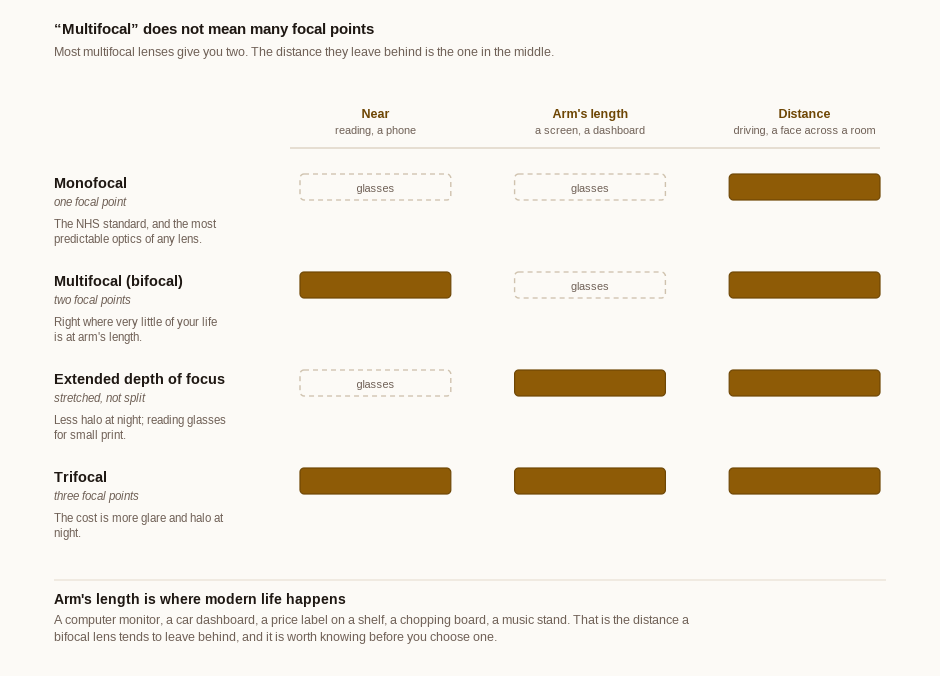
- Trifocal lens replacementFocuses distance, middle and near at once. The trade-off is halos and glare around lights at night.
- Multifocal lens replacementDespite the name, usually distance and near only — the gap is at arm's length.
- Cross-linking for keratoconusIt stops the condition getting worse. It does not correct your vision — and keratoconus is an absolute bar to laser surgery.
- Ptosis surgeryA lid that droops because the muscle is weak, not because the skin is loose. Removing skin will not raise it — which is why people have the wrong operation.
- Cataract surgeryThe same operation, done once the lens has clouded. On the NHS in Britain with a monofocal lens — so privately, you are buying the lens.
We also arrange monofocal lenses, and YAG capsulotomy, which clears the membrane behind the lens years later and takes minutes. There is no separate page for these yet — ask and a surgeon will tell you whether it applies to you.
Eyelids
Mostly cosmetic, sometimes not: a lid that has dropped far enough to block vision is a functional operation, not an aesthetic one.
- Eyelid surgeryExcess skin on the upper lid, herniated fat on the lower lid, or both.
- Eye bag removalLower lid only. Fat repositioned rather than simply removed — because an emptied eye looks worse with age than a full one.
We also arrange upper lids alone, eyelid surgery planned for men, ptosis correction where the lid muscle itself is weak, and fox eye surgery. There is no separate page for these yet — ask and a surgeon will tell you whether it applies to you.
Medical eye conditions
Treatment rather than correction. These are arranged differently and some of them are not single-visit procedures at all.
We also arrange dry eye treatment, vitrectomy, and intravitreal injections, which are a repeating course rather than a one-off. There is no separate page for these yet — ask and a surgeon will tell you whether it applies to you.
Is the problem in the clear window at the front of your eye, or in the lens inside it?
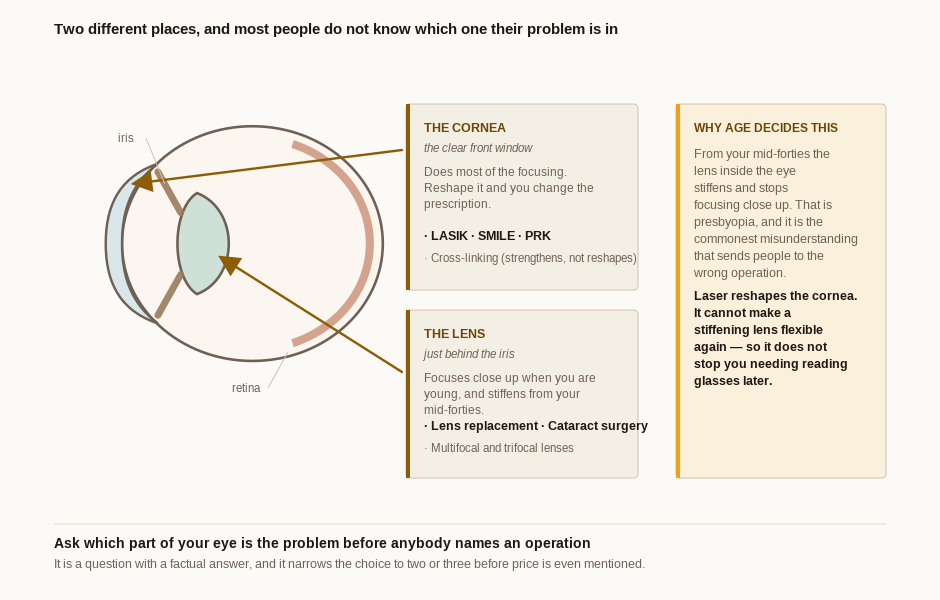
Age decides most of this. If you are under about forty and want to stop wearing glasses for distance, it is the cornea. If you are past your mid-forties and reading is the problem, the lens inside your eye has stiffened and no laser can make it flexible again.
- Short sight, long sight or astigmatism, and I am under fortyThe cornea is reshaped. This is what laser does, and it does it well within a defined range of prescriptions. → Laser eye surgery £2,400 · 7 nights£1,350 treatment only
- I want no flap made at allSMILE reshapes the cornea without lifting a flap. Narrower range, and an enhancement later is more involved. → SMILE laser surgery
- Reading is the problem and I am past forty-fiveThe lens itself has stiffened. Laser reshapes the cornea and cannot change that, so a lens is the discussion. → Lens replacement surgery
- My vision has clouded rather than blurredThat is a cataract. The same operation as lens replacement, done because the lens has clouded. → Cataract surgery
- I have been told I have keratoconusCross-linking strengthens the cornea to stop it worsening. It does not correct vision, and keratoconus is an absolute bar to laser surgery. → Cross-linking for keratoconus
- I am not sure which of these I haveNobody can tell from a form. Send your prescription and any recent test results and we will tell you which options are even open.
| Treatment | Complete care price | Nights with us | Anaesthetic | In theatre |
|---|---|---|---|---|
| Laser eye surgery | £2,400 · €2,880£1,350 · €1,620 treatment only | 7 nights | Anaesthetic drops | around ten to fifteen minutes |
| SMILE laser surgery | On request | Day case | Anaesthetic drops | Not published |
| Lens replacement surgery | On request | Not published | Not published | Not published |
| Cataract surgery | On request | Day case | Anaesthetic drops | ten to fifteen minutes |
| Cross-linking for keratoconus | On request | Day case | Anaesthetic drops | around thirty to sixty minutes |
Prices are the published complete-care figure unless marked otherwise, and a dash means we do not publish a single figure for that treatment — ask and we will tell you. Times and nights are typical, not promises.
Almost every eye decision comes down to one question first
Is the problem in the cornea, the clear window at the front, or in the lens inside the eye? They are different places, they fail in different ways, and the operations that address them have almost nothing in common. Get the answer to that question and the choice narrows to two or three before anybody mentions price.
1. Which part of the eye each treatment changes
Two places, and most people do not know which one their problem is in.
2. If it is the cornea: PRK, LASIK or SMILE
All three reshape the same tissue. They differ in how they reach it.
3. If it is the lens: which lens, and what each one leaves out
“Multifocal” does not mean many focal points.
Two things worth knowing before anybody quotes you
- Replacing a clear lens is cataract surgery, done early. That is not an argument against it — it is among the most performed operations in medicine. But it is permanent, and the lens you choose is the decision, not the surgery.
- In Britain, cataract surgery is available on the NHS. What people pay for privately is almost always the lens rather than the operation. Worth knowing what you are actually buying.
Eyelids are a different question, with their own diagrams
Nothing above concerns the lids. If what bothers you is hooding, a bag, or a lid that sits low, the eyelid diagrams set out the three different reasons an upper lid looks heavy — skin, brow or muscle — and why each needs a different operation.
Read the page for the one being discussed with you
- Laser eye surgery LASIK and PRK. Reshapes the cornea; does not touch the lens.
- SMILENo flap. That is the whole argument for it, and the limits follow from the same fact.
- Lens replacementThe lens inside the eye, replaced. Which lens is the decision.
- Trifocal lens All three distances, with a night-vision trade-off.
- Multifocal lens Usually two distances. The gap is arm's length.
- Cataract surgery The same operation, done because the lens has clouded.
- Cross-linking Strengthens the cornea to stop keratoconus worsening. It does not make you see better, and expecting that is how people end up disappointed by a treatment that worked.
What is different about doing this with us
You do not recover in a hotel room
The week after surgery is spent at Mandarin Grove, our own retreat in Urla. Our team is there around the clock, and at the first doubt your surgeon is brought in rather than a stranger on duty.
About the retreatMeet the specialists in the UK first
Every three months we hold consultation meetings in UK cities, and have done for fifteen years. You can be seen in person, ask your questions, and decide afterwards — having booked nothing.
Upcoming datesThe same surgeon, months later
Our contracted surgeons have been with Revitalize for years. If a question comes up after you are home, you return to the same surgeon through the same team.
Contracted surgeonsWhat your quotation should itemise
Eye surgery is quoted per eye and after measurement. For laser, the figure depends on the technique your cornea allows; for a lens, on which lens is fitted — and that is the biggest single variable in the total.
One item to watch on any quotation, ours included: if you have astigmatism, the lens that corrects it costs more than the standard one. That addition belongs in the written figure before you travel, not in a conversation at the clinic.
- Clinical careThe named surgeon and facility, the procedure, anaesthesia, tests, hospital nights and planned reviews.
- StayNights at the retreat, the room arrangement and which meals are included.
- TransfersWhich airport, hospital and clinic journeys are covered.
- AftercareClinical checks, dressing or suture appointments, medicines, and how to reach the team once you are home.
- Charged separatelyFlights, insurance, a companion's costs, extra nights and changes to travel dates.
Eye surgery — every treatment we arrange, at a glance 11 treatments
| Treatment | Complete care price | Nights with us | Anaesthetic | In theatre |
|---|---|---|---|---|
| Laser eye surgery | £2,400 · €2,880£1,350 · €1,620 treatment only | 7 nights | Anaesthetic drops | around ten to fifteen minutes |
| SMILE laser surgery | On request | Day case | Anaesthetic drops | Not published |
| Lens replacement surgery | On request | Not published | Not published | Not published |
| Trifocal lens replacement | £3,950 · €4,740£2,900 · €3,480 treatment only | 7 nights | Local anaesthetic | around fifteen to thirty minutes |
| Multifocal lens replacement | On request | Not published | Anaesthetic drops | around ten to fifteen minutes |
| Cross-linking for keratoconus | On request | Day case | Anaesthetic drops | around thirty to sixty minutes |
| Ptosis surgery | £2,675 · €3,210£1,625 · €1,950 treatment only | 7 nights | Sedation | about one hour |
| Cataract surgery | On request | Day case | Anaesthetic drops | ten to fifteen minutes |
| Eyelid surgery | £2,850 · €3,420£1,800 · €2,160 treatment only | 7 nights | Local anaesthetic | one to two hours |
| Eye bag removal | £2,275 · €2,730£1,225 · €1,470 treatment only | 7 nights | General anaesthetic | about one hour |
| Glaucoma treatment | On request | Day case | Local anaesthetic | about one hour |
Prices are the published complete-care figure unless marked otherwise, and a dash means we do not publish a single figure for that treatment — ask and we will tell you. Times and nights are typical, not promises.
See the published price list — indicative figures only; the one that applies to you is in your written plan. If you are holding a UK quotation, this is what actually differs.
If something goes wrong, or the problem returns
A complication. Surgical treatment is guaranteed for one year from the date of treatment. The guarantee covers medical complications and any further surgery that becomes clinically necessary as a result; that treatment is carried out in İzmir at no charge. Full terms and exclusions.
A problem that comes back. This is a different matter and we will not promise it away. Some conditions recur, and a recurrence years later is not a complication of the first operation. Whether further surgery is appropriate, and what it would cost, is a fresh clinical decision. Any surgeon who tells you a result of this kind is guaranteed for life is telling you something the medical literature does not support.
We would rather say that before you book than afterwards.
How the process works
Free online consultation
You describe the problem. We pass it to the surgeon for preliminary review.
Written plan
Named surgeon, named hospital, proposed procedure and an itemised total — before you book anything.
Assessment in İzmir
Health checks, tests and an in-person meeting with your surgeon. Final approval happens here.
Surgery and hospital stay
Monitored recovery and nursing support.
Recovery and going home
Your stay at the retreat, review appointments, clearance to fly, and a route back to your surgeon afterwards.
Our treatment process · Recovery and aftercare · Contracted hospitals · Reviews and UK press
Questions people ask
Am I suitable for laser eye surgery?
It depends on your prescription, the thickness and shape of your cornea, and whether you have dry eye or keratoconus. A proportion of people who want laser are not suitable for it, and the honest answer in those cases is a lens or nothing. Measurements decide this, not an enquiry form.
Is lens replacement the same as cataract surgery?
Technically yes — the natural lens is removed and an artificial one put in its place. The difference is timing and intent: a cataract operation is done because the lens has clouded, a refractive lens exchange because you want to stop depending on glasses.
What is the catch with a trifocal lens?
Night vision. Trifocal lenses split light between three focal points, and most people see halos or starbursts around lights in the dark, particularly when driving. For most it settles into something they stop noticing; for some it does not. Anyone who does not mention this is not describing the lens accurately.
Will laser surgery mean I never need glasses?
It can remove your distance prescription. It does not stop the lens inside your eye stiffening with age, so reading glasses usually arrive in your forties regardless. If you are already past that point, laser alone will not deal with near vision and a lens may be the better discussion.
Does astigmatism cost extra?
With a lens, yes — the toric lens that corrects astigmatism is an addition to the standard figure. Make sure it appears in your written quotation before you travel. With laser it is usually included in the technique price.
Send us your prescription
An eye test result tells a surgeon more than any description can. Send your prescription, the date it was taken, and whether you have been told anything about corneal thickness, dry eye or keratoconus.
The consultation is free and nothing is booked at this stage.
Before any of this, you can meet the surgeon in person. We hold free consultations in British cities every three months — next in London on 9 January and Manchester on 10 January. If we are not near you, say so and we will tell you when we are.
The information on this page is general and does not replace an individual assessment by the treating surgeon. It is not medical advice, diagnosis or treatment. Individual results vary.