 Private patient care since 2005
Facelift in Turkey
A facelift repositions the layer underneath your skin and removes what is then surplus. It does not change skin texture, it does not treat the lines around your mouth, and it does not stop you ageing. What it does is give back a jawline.
You can meet the surgeon in Britain first, and you should — this is an operation where the conversation about how much is enough matters more than the technique. The plan you are given names the surgeon, names the hospital and itemises the cost before you commit.
In short
- Price
- £3,775 complete care · £2,725 treatment onlyabout $5,000 and $3,610 · 7 nights
- Anaesthetic
- Sedation or general anaesthetic
- In theatre
- Around three to five hours
- Hospital stay
- Two nights in hospital
- Flying home
- Day seven, after your sutures are out and your surgeon has cleared you.
- Not for you if
- You are hoping to improve your skin itself Texture, pigmentation, fine lines and sun damage need resurfacing, not lifting.
If this turns out not to be the right operation for you: Deep plane facelift, Ear correction, Neck lift.
What a facelift actually lifts
Under the skin of your face there is a fibrous layer called the SMAS, which carries the fat and muscle of the cheek and jaw. Ageing does not mainly loosen your skin; it loosens that layer, and the skin follows it down. A facelift lifts and secures that layer in a better position, then removes the skin that has become surplus as a result. The incisions run in front of the ear, into the hairline at the temple, and behind the ear.
Because it works on the deeper layer, a facelift gives back definition along the jaw and softens the jowls and the fold that runs from the corner of the mouth down. That is its territory: the lower two-thirds of the face and, with a neck lift added, the line under the jaw.
It leaves a great deal alone. It does nothing for skin quality — sun damage, thinning, open pores, fine lines in the skin itself are treated by resurfacing and by what you do with sunscreen, not by surgery. It does little for the lines around the lips. It is not an eyelid operation, and heavy upper lids or under-eye bags need their own procedure, which is often done at the same time. And it does not stop the clock: you will carry on ageing from the new position, which is why most people who have one are pleased with it for a long time but not forever.
The figure in our published list is for a SMAS facelift carried out under twilight sedation, which is the operation most people mean and the one most people need. One thing worth knowing before you compare prices, here or anywhere: in our own list a deep plane facelift under the same twilight sedation is priced identically to this operation. The step up to the higher figure is the general anaesthetic that a longer, deeper dissection usually calls for — not a premium on the technique itself. So the question to ask your surgeon is not which operation costs more. It is which one your face actually needs, and for most faces the answer is this one.
SMAS, deep plane, mini and mid-face — what actually differs
Four names get used as though they were four products. They are not. They are four answers to one question: how deep do you go, and what do you release once you are there? Everything else — how natural it looks, how long it lasts, how long you swell — follows from that answer.
The three diagrams below are the whole argument. If you read nothing else on this page, read these.
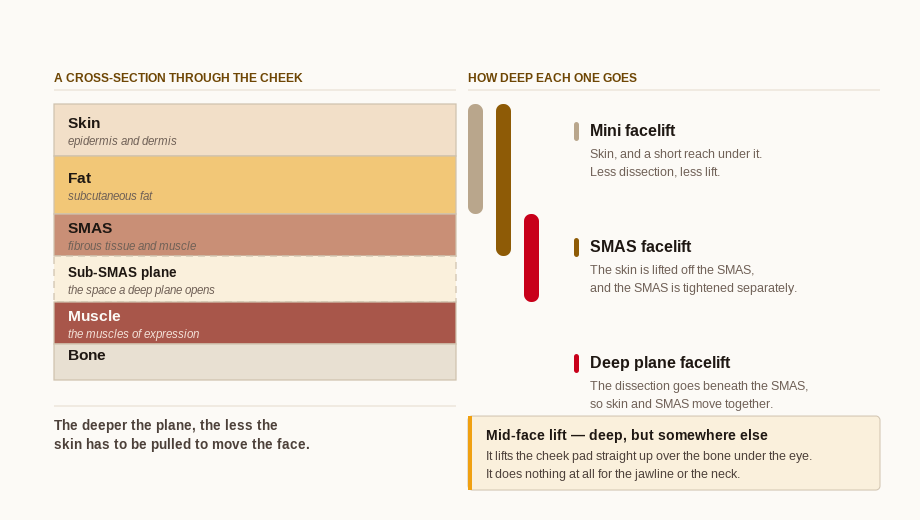
1. The face is a stack of layers, and each operation works at a different depth
Skin, fat, the SMAS, the plane beneath it, then muscle and bone.
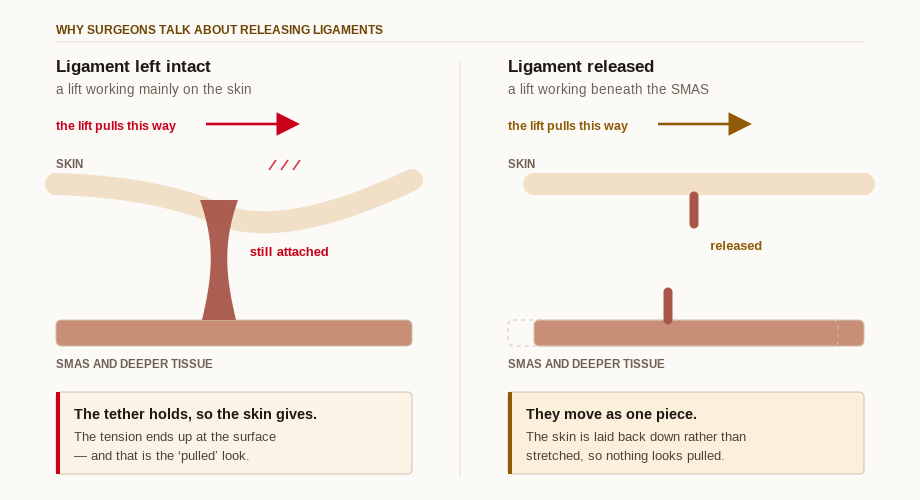
2. The retaining ligaments, and why surgeons keep talking about releasing them
This is the single idea that explains the difference between a natural result and a pulled one.
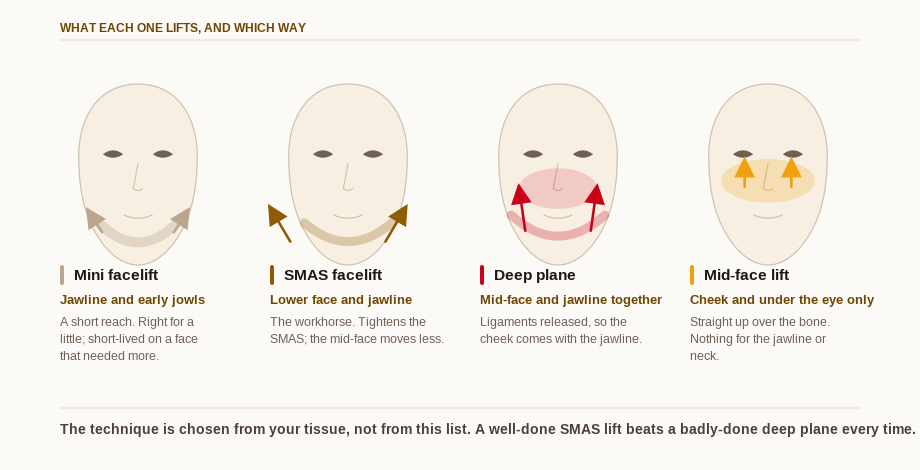
3. Each one lifts a different part of the face, in a different direction
Depth is half the story. The other half is territory and vector.
So which one is better?
None of them, in the abstract — and the question is worth distrusting when a clinic answers it quickly. The technique is chosen from your tissue: how thick and elastic your skin is, where the descent actually is, whether your mid-face has dropped or only your jawline, your age, whether you smoke, and what you are prepared to swell for.
Two things are worth holding on to when you compare quotations:
- A well-executed SMAS lift beats a badly-executed deep plane every time.Depth is a tool, not a guarantee. The deep plane is the more demanding operation and it is unforgiving of a surgeon who is not practised in it. The name on the quotation tells you nothing about the hands.
- A deep plane lift genuinely does something a SMAS lift cannot. Where the mid-face has dropped and the folds beside the nose are the complaint, releasing the ligaments is how you move the cheek. Tightening the SMAS alone moves it much less. That is anatomy, not marketing.
What should worry you is a clinic that offers one technique to everyone, or that sells a technique before anyone has examined your face. What should reassure you is a surgeon who tells you which one they are proposing, why, and what the alternative would have given you.
Read the page for the one being proposed to you
- SMAS faceliftThe one most people are actually having, under whatever name. Tightens the layer beneath the skin; very effective for the jawline and neck.
- Deep plane facelift Releases the retaining ligaments and moves skin and SMAS as one unit. Usually preferred where the mid-face is the complaint.
- Mini faceliftA shorter scar means less dissection, and less dissection means less lift. Right for early jowling; short-lived in a face that needed more.
- Mid-face liftRaises the cheek and softens the hollow under the eye. It does nothing for the jawline or neck, which is what makes it right or wrong for you.
- Neck liftOften combined, because a lifted face above an untreated neck is the giveaway people notice.
Variations, and the one most often confused
SMAS facelift
The operation this page and this price describe. The SMAS layer is lifted and fixed, the surplus skin removed. Reliable, well understood, and enough for the large majority of faces.
Deep plane facelift
A deeper dissection that releases the ligaments holding the mid-face down and moves skin and deep layer as one unit. It can do more for a heavy mid-face and a deep nasolabial fold. It is longer, more technically demanding, and separately priced — see its own page rather than assuming it is an upgrade you can add on the day.
Short-scar or mini lift
Less dissection, shorter scars, less achieved. It suits early changes in a younger face and is a poor substitute where there is real laxity, because it will relapse quickly and you will have paid for a scar and a short-lived result.
Neck lift as an addition
Most people who want a facelift also mean the neck. Tightening the platysma muscle and treating the fat under the chin is a priced addition when combined with a major operation, and it is usually what makes the difference between a good result and the result you had in mind.
Eyelids, brow and volume
Upper or lower eyelid surgery, a temporal lift, a lip lift and fat transfer are all priced as additions to a major operation in our list. A face lifted without addressing tired eyes can look oddly mismatched, and our doctors will tell you honestly which of these you need and which you do not.
What it costs, and what each figure covers
Complete care
£3,775about $5,000 · €4,530
7 nights. Everything in the treatment-only package, plus your stay at Mandarin Grove on half board under 24-hour supervision, private nursing and a chaperone during your hospital stay, every transfer, your check-ups organised and driven, the follow-up care programme in the UK, and the revision guarantee.
Treatment only
£2,725about $3,610 · €3,270
Your consultation and pre-operative tests, the operation, a private hospital room, your first course of medications, appointment coordination and a post-operative garment where one is needed. Your check-ups are booked for you, but you make your own way to them: the stay at Mandarin Grove, the transfers, the UK follow-up programme and the revision guarantee are not included.
Both are published figures for a SMAS facelift under twilight sedation, not quotations for you: the technique, how much surgery is involved and the nights you need all change them, and your own total is confirmed in writing after a surgeon has reviewed your case.
| Item | Treatment only | Complete care |
|---|---|---|
| Pre-operative consultationWith the surgeon who will operate, before anything is booked. | Included | Included |
| Standard pre-operative testsCarried out in İzmir if you have not had them at home. | Included | Included |
| Private hospital roomA room of your own for your hospital nights. | Included | Included |
| First course of medicationsThe post-operative medicines you leave hospital with. | Included | Included |
| Appointment coordination serviceYour hospital, surgeon and clinic appointments arranged around each other. | Included | Included |
| Post-operative garment if neededOne garment, where the operation calls for one. | Included | Included |
| Post-operative check-upsThe review appointments after your operation, booked around each other and carried out before you are cleared to fly. | Included | Included |
| Private nursing during your hospital stayNursing care of your own while you are in hospital, over and above the ward's own staff. | Not included | Included |
| Chaperone service during your hospital staySomeone with you in the hospital, not only at visiting hours. This is separate from the nursing care and you have both. | Not included | Included |
| Five, seven or ten nights at Mandarin GroveOur own retreat, not a hotel. How many nights depends on the operation. | Not included | Included |
| 24/7 patient care at Mandarin GroveYou are under our supervision around the clock, alongside the other patients recovering there rather than alone in a room. Whatever you need at whatever hour is dealt with, and anything medical is taken up with the medical staff for you rather than left to you to chase. | Not included | Included |
| Breakfast and dinner at Mandarin GroveHalf board for the whole stay. | Not included | Included |
| Transfers to and from the airport, hospital and clinicEvery local journey, private. | Not included | Included |
| Your check-ups organised and drivenWe arrange each review appointment and take you there and bring you back. On the treatment-only package the appointments are still booked for you, but you make your own way to each one. | Not included | Included |
| The follow-up care programme in the UKFollow-up continues once you are home, including post-operative checks at our in-person UK consultations. | Not included | Included |
| Revision guaranteeWhere a revision falls within it, the surgical team does not charge for it. Flights, accommodation, and anaesthesia and hospital fees where they apply, remain yours. | Not included | Included |
| Charged separatelyFlights, insurance, a companion’s costs, extra nights, additional tests and changes to travel dates. | Not included | Not included |
| Published priceNot a quotation for you: a surgeon confirms your own figure in writing. | £2,725about $3,610 · €3,270 | £3,775about $5,000 · €4,530 |
| Nights includedWhere you sleep is the main difference between the two figures. | None — your own arrangements | 7 nights with us |
Both figures are published prices for a SMAS facelift under twilight sedation. What changes them is the technique, how much surgery is involved and the nights you need — which is why your own total is confirmed in writing only after a surgeon has reviewed your case.
See the full published price list · how a Turkish quote compares with a UK one
Who a facelift suits
You have laxity and jowling, with reasonable skin quality
The operation moves tissue. It works best where there is tissue worth moving and skin that will settle onto the new shape.
Your weight is stable
Significant loss after a facelift leaves volume gaps; significant gain blurs the jawline you paid for.
Your blood pressure is controlled
The commonest early complication is bleeding under the skin flap, and uncontrolled hypertension is the biggest avoidable contributor. Our doctors will check it and will postpone rather than take the risk.
You do not smoke
A facelift raises a large flap of skin that has to survive on its remaining blood supply. In smokers that skin can die, and the result is a scar nobody can fix. This is close to an absolute requirement.
You want to look rested rather than different
The patients who are happiest are the ones who wanted their jawline back, not a new face.
When the honest answer is no, or not yet
You are hoping to improve your skin itself
Texture, pigmentation, fine lines and sun damage need resurfacing, not lifting. Our doctors will tell you if that is the main thing bothering you, even though it is a smaller sale.
You smoke and will not stop
No. See above.
You want to look twenty years younger
A facelift sets you back a number of years in one specific respect. The people who chase more than that are the people who end up looking pulled, and a surgeon who agrees to it is not doing you a favour.
Your blood pressure or general health is not under control
This is elective surgery under sedation or anaesthesia near the airway. It waits until you are safe.
Whether it suits you is decided by assessment, not by a photograph or a price list. A surgeon who thinks the operation is wrong for you will tell you so — that has happened often enough to be reported in the UK press.
How the process works
Free consultation
Online, or in person at a UK consultation. You share your aims, relevant history and photographs; a surgeon reviews them.
Written plan
The named surgeon, the named hospital, the proposed procedure and an itemised total — before you book anything.
Assessment in İzmir
Health checks, tests and an in-person meeting with your surgeon. Final approval happens here, not before.
Surgery and hospital stay
A SMAS facelift is usually carried out under twilight sedation with local anaesthesia, and takes around three to five hours; a more extensive lift or a combination may be done under general anaesthesia. You stay one or two nights in the hospital with your head elevated, and sometimes with a small drain.
Mandarin Grove, then home
Your recovery stay, review appointments, clearance to fly, and a route back to the same surgeon afterwards.
What recovery usually looks like
These are general milestones, not a promise. Healing varies, and your own timeline is set by your surgeon.
Days two to four
Bruising and swelling are at their worst, usually asymmetrically, and one side looking different from the other at this stage means nothing. You sleep propped up. You are with our team, which matters most here: bleeding under the skin flap is the one complication where hours count, and it is the reason we do not send facelift patients to a hotel.
The first two weeks
Sutures come out around day seven, before you fly. Bruising moves down the neck and yellows. Most people are presentable to strangers at two to three weeks with a little makeup, and not before.
One to three months
Numbness and odd tight sensations in front of the ear are normal and settle over weeks to months. The face relaxes from the slightly over-tight look of the early weeks into its real shape at around three months.
Six to twelve months
Scars in front of the ear mature and fade; the ones in the hairline disappear into it. This is when the result is assessed properly.
Flying home
Day seven, after your sutures are out and your surgeon has cleared you.
You do not recover in a hotel room
The week after surgery is when being far from home actually matters. You spend it at Mandarin Grove, our own recovery retreat in Urla — not in a hotel, and not on your own.
A hotel is built for tourists. Reception changes shift, nobody knows what operation you had, and if you wake at three in the morning unsure whether what you are feeling is normal, there is no one to ask. That is the part of treatment abroad that goes wrong, and it is the part we built around.
The stay described here comes with the complete care package, along with your transfers and your check-ups organised and driven. On the treatment-only package your appointments are still booked for you, but where you stay and how you get to each one are yours to arrange — which is the difference between the two published figures.
- Someone checks on you, through the nightOur team is there around the clock. You are never left to work out on your own whether a symptom is normal — that judgement is not the patient's job.
- At the first doubt, your surgeon is involvedNot a call centre and not a stranger on duty. The surgeon who operated on you is brought in, which is why small concerns stay small.
- You are among people going through the same thingMeals and conversation with other patients at the same stage, rather than a locked room and a television.
- Food planned for healing, and quietMeals prepared for people recovering from surgery. No lobby traffic, no tour groups, no noise.
Risks, and what happens afterwards
Every operation carries risk. These are the ones that apply here, and you should hear them from us before you hear them from anyone else.
Haematoma
Bleeding under the lifted skin, the commonest early problem. It needs recognising and releasing quickly, which is an argument for being near your surgeon in the first days rather than in another country.
Nerve injury
Temporary weakness of a facial muscle or an area of numbness is not unusual and recovers over weeks to months. Permanent injury to a branch of the facial nerve is rare, and it is the risk that makes this an operation for surgeons who do it often.
Skin flap problems
Particularly behind the ear, and particularly in smokers, the skin at the edge of the flap can fail and heal with a poor scar.
Scars
Usually well hidden, but they are permanent, they can widen, and in some skin types they thicken. The scar behind the ear is the one most likely to be visible with short hair.
Earlobe distortion
If the skin is closed under tension the lobe can be pulled downward and forward — the pixie ear. It is avoidable with care and correctable, but it is a giveaway and worth asking your surgeon about.
Hair loss at the incisions
A band of thinning in the temporal hairline, usually temporary.
Asymmetry
Your face was not symmetrical before. It will not be afterwards either.
Looking operated on
The risk nobody lists. It comes from over-tightening skin instead of repositioning the deeper layer, and from doing too much at once. The protection against it is a surgeon willing to do less than you ask.
If something goes wrong: the one-year guarantee
Surgical treatment arranged through Revitalize is guaranteed for one year from the date of treatment. The guarantee covers medical complications arising from the treatment, and any revision that becomes clinically necessary as a result. Where a claim falls within it, the revision is carried out in İzmir by the same treating team and the team does not charge for it.
The revision guarantee comes with the complete care package. What it does not cover, in any package, is the practical cost of coming back: your flights, your accommodation, and — where they apply to the revision — the anaesthesia and hospital fees. Those are told to you in writing before anything is arranged, so that the guarantee is a figure you can check rather than a word.
Taking the result further: second-stage revision
This is a different thing from the guarantee, and worth understanding before you book, because most second operations are not about anything going wrong.
What drives a second stage in a facelift is skin elasticity — how far your own skin retracts onto the new shape after the deeper layer has been repositioned. That is a property of your tissue, not of the operation, and no surgeon can measure it in advance; it only shows itself over the months afterwards. In a face with less elastic skin, a small amount of surplus can reappear in front of or below the ear at around six months. Taking it then, as a short procedure, gives a cleaner jawline and a better scar than over-tightening at the first operation would have done — and over-tightening at the first operation is precisely what produces the pulled look people are afraid of. So the second stage is not a correction of a mistake. It is the safer half of a deliberate two-step.
Where our doctors judge that a further operation can genuinely take the result further, they do it without charging a surgeon's fee. You cover only the practical expenses of arranging it — accommodation, transfers, and the theatre fee where one applies. Patients sometimes end up having had two operations for close to the price of one. What that figure covers in your case is confirmed to you in writing beforehand.
And if they judge that nothing further can be achieved, no revision is performed. We do not take that risk and we do not ask you to take it either.
Read the full guarantee, the exclusions, and what patients have complained about
The surgeon is named before you book a flight
Your written plan names the surgeon and the hospital, so you can check their registration and specialty before you commit to anything. They are the same doctors you would go back to a year later if something needed attention — which is the practical reason continuity matters more than it sounds.
Our contracted surgeons · The hospitals we use · Patients describing their own week
Questions people ask
Where will the scars be?
In front of the ear, up into the temporal hairline, and behind the ear into the hairline at the back. The front one is the one people see; it sits in a natural crease and fades well in most skin.
Will I look pulled?
Not if the operation is done on the deeper layer and not overdone. If you ask for more than your face can take, a good surgeon will say no — and that refusal is worth more than a discount.
Does it do anything for my neck?
Some, along the jawline. If the neck itself is what bothers you, a neck lift is the addition you want, and it is priced as an addition in our list.
How long does it last?
You carry on ageing from a better starting point. Most people are happy for a long time; a proportion consider something further after a decade or so.
Twilight sedation or general anaesthesia?
The published price is for twilight sedation, which suits most SMAS facelifts and avoids a general anaesthetic. Your surgeon may advise general anaesthesia for a longer or combined operation, and if so your written plan will say so and say what it costs.
Can I have my eyelids done at the same time?
Commonly, yes, and it is priced as an addition. A lifted face with tired eyes can look mismatched.
Will it help the lines around my mouth or my skin quality?
Very little. Those need resurfacing or injectables, which are different treatments. Our doctors will tell you so rather than sell you a lift that will not fix what is bothering you.
When can I be seen in public?
Two to three weeks for most people, with makeup. Three months before it looks like your face rather than a recent operation.
Request a written plan
Tell us what bothers you most — the jawline, the jowls, the neck, the eyes — and whether you have had facial surgery or injectables before. It matters because the answer decides whether you need a lift, something else, or a combination.
There is no charge for the consultation and no obligation to book.
Before any of this, you can meet the surgeon in person. We hold free consultations in British cities every three months — next in London on 9 January and Manchester on 10 January. If we are not near you, say so and we will tell you when we are.
Medically reviewed by Prof. Dr. Ahmet Seyhan · Last reviewed .
The information on this page is general and does not replace an individual assessment by the treating surgeon. It is not medical advice, diagnosis or treatment. Individual results vary. Medical decisions should be made with a qualified healthcare professional.