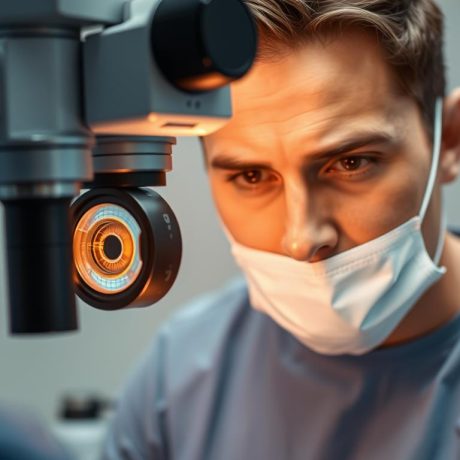

SMILE Pro eye surgery is the latest generation of keyhole laser vision correction, performed on the ZEISS VISUMAX 800 platform. It corrects short-sightedness (myopia) and astigmatism through a tiny 2–4mm incision — without creating the larger corneal flap that traditional LASIK requires. The “Pro” upgrade reduces the laser time to form the corneal lenticule to around 10 seconds, adds automated centration and cyclotorsion control for greater precision, and makes the procedure faster and more comfortable than earlier SMILE. This guide explains exactly how SMILE Pro eye surgery works, how it compares to LASIK and standard SMILE, who’s a suitable candidate, the cost in Turkey versus the UK, the recovery timeline, and the results you can realistically expect.
SMILE Pro is a genuine technological step forward in refractive surgery — but it isn’t right for everyone, and an honest assessment matters. This article covers the candidacy criteria and limitations as carefully as the benefits, because choosing the right procedure for your eyes is more important than choosing the newest one. Information here is consistent with ZEISS clinical materials and Royal College of Ophthalmologists guidance.
Table of contents
- The short answer
- What is SMILE Pro eye surgery?
- How SMILE Pro works — step by step
- SMILE Pro vs LASIK vs standard SMILE
- SMILE Pro eye surgery — at a glance
- Who is a candidate for SMILE Pro?
- Recovery timeline
- Results and success rates
- SMILE Pro cost — Turkey vs UK
- Risks and side effects
- Why have SMILE Pro in Turkey?
- Frequently asked questions
- What to do next
The short answer
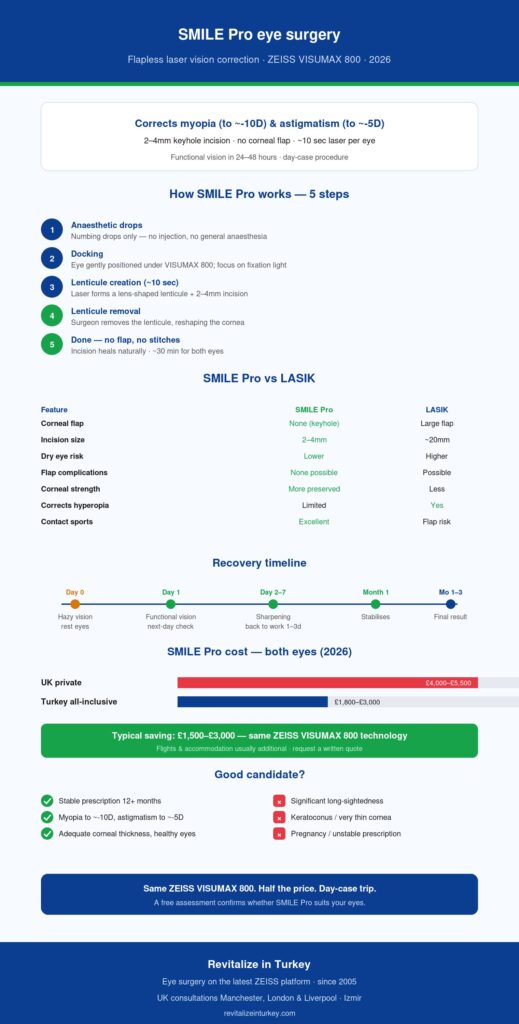
SMILE Pro eye surgery is a flapless, minimally invasive laser vision correction procedure on the ZEISS VISUMAX 800. It corrects myopia (up to around -10 dioptres) and astigmatism (up to around -5 dioptres) by using a femtosecond laser to create a thin lens-shaped piece of tissue (a lenticule) inside the cornea, which the surgeon removes through a 2–4mm keyhole incision. Because there’s no large corneal flap, SMILE Pro typically has lower rates of dry eye than LASIK, preserves more corneal biomechanical strength, and has no flap-related complications. The procedure takes a few minutes per eye, most patients see clearly within 24–48 hours, and results are comparable to LASIK for suitable candidates. In Turkey, SMILE Pro typically costs £1,800–£3,000 for both eyes — roughly 40–60% less than UK private pricing.
What is SMILE Pro eye surgery?
SMILE stands for Small Incision Lenticule Extraction. It’s a third-generation laser vision correction technique, after PRK (surface ablation) and LASIK (flap-based). SMILE Pro is the most advanced version, running on the ZEISS VISUMAX 800 — the newest femtosecond laser platform.
The defining feature of SMILE Pro eye surgery is that it’s flapless. LASIK works by cutting a hinged flap in the cornea, lifting it, reshaping the tissue beneath with an excimer laser, then replacing the flap. SMILE Pro instead uses a single femtosecond laser to create a precise disc of tissue (the lenticule) within the intact cornea, which the surgeon then removes through a tiny incision. The cornea’s surface stays almost entirely intact.
The “Pro” generation adds several refinements over earlier SMILE:
- Faster lenticule creation — around 10 seconds per eye, versus roughly 23 seconds in earlier SMILE, reducing the time you need to hold fixation.
- Automated centration — the system centres the treatment on your visual axis precisely.
- Cyclotorsion control — compensates for the slight rotation of the eye between sitting and lying down, important for accurate astigmatism correction.
- Smoother, more comfortable experience — faster docking and treatment.
How SMILE Pro works — step by step
Step 1 — Anaesthetic drops. Numbing eye drops are applied. No injections, no general anaesthesia. You’re awake and comfortable throughout.
Step 2 — Docking. The eye is gently positioned under the VISUMAX 800. A soft contact glass holds the eye steady. You focus on a fixation light.
Step 3 — Lenticule creation (~10 seconds). The femtosecond laser creates a precise lens-shaped lenticule within the cornea, and a small 2–4mm incision at its edge. This is the part that defines your new prescription.
Step 4 — Lenticule removal. The surgeon gently separates and removes the lenticule through the keyhole incision. Removing this tissue reshapes the cornea, correcting your vision.
Step 5 — Done. No flap to reposition, no stitches. The small incision heals naturally. The whole procedure takes a few minutes per eye; you’re usually in and out of the treatment suite within 30 minutes for both eyes.
SMILE Pro vs LASIK vs standard SMILE
| Feature | SMILE Pro | LASIK | Standard SMILE |
|---|---|---|---|
| Corneal flap | None (keyhole) | Large hinged flap | None (keyhole) |
| Incision size | 2–4mm | ~20mm flap edge | 2–4mm |
| Laser platform | ZEISS VISUMAX 800 | Femtosecond + excimer | ZEISS VISUMAX 500 |
| Lenticule time | ~10 seconds | n/a | ~23 seconds |
| Corrects myopia | Yes (to ~-10D) | Yes | Yes |
| Corrects astigmatism | Yes (to ~-5D) | Yes | Yes |
| Corrects hyperopia | Limited / not standard | Yes | Limited |
| Dry eye risk | Lower | Higher | Lower |
| Flap complications | None possible | Possible (dislocation, wrinkles) | None possible |
| Corneal strength preserved | More | Less | More |
| Suitable for contact sports | Excellent (no flap to dislodge) | Good but flap risk | Excellent |
The key takeaways: SMILE Pro and standard SMILE both avoid the flap, which means lower dry eye risk and no flap-related complications — a meaningful advantage for people in contact sports, the military, or physically demanding jobs. SMILE Pro improves on standard SMILE with faster, more precise treatment. LASIK retains an edge for correcting long-sightedness (hyperopia), which SMILE doesn’t standardly treat.
Who is a candidate for SMILE Pro?
SMILE Pro eye surgery suits many people seeking freedom from glasses and contact lenses, but not everyone. A proper assessment — corneal topography, pachymetry (thickness), refraction stability — determines candidacy. Typical criteria:
Good candidates:
- Aged 18+ (typically 21+ for elective treatment) with a stable prescription for at least 12 months.
- Myopia up to around -10 dioptres.
- Astigmatism up to around -5 dioptres.
- Adequate corneal thickness.
- Healthy eyes — no significant cataract, glaucoma, keratoconus or severe dry eye.
- Realistic expectations.
- Particularly good fit for athletes, military/police, and anyone wanting to avoid flap-related risk.
Not suitable (or needs alternative):
- Significant long-sightedness (hyperopia) — LASIK or lens-based surgery may suit better.
- Very thin corneas or keratoconus — may need a different approach.
- Unstable prescription, pregnancy/breastfeeding (refraction can shift).
- Certain eye or autoimmune conditions.
- Presbyopia (age-related reading difficulty) — usually better addressed with lens replacement surgery.
If SMILE Pro isn’t right for your eyes, a reputable clinic will tell you and recommend the more suitable option — LASIK, PRK, lens replacement or phakic IOL. Choosing the right procedure matters more than choosing the newest.
Recovery timeline
SMILE Pro recovery is among the fastest in refractive surgery, thanks to the flapless, surface-sparing technique:
- Day of surgery: Vision is hazy for a few hours. Mild irritation, watering and light sensitivity are normal. Rest with eyes closed; you’ll go home (or to your hotel) the same day.
- Day 1: Most patients wake with functional vision and attend a next-day check. Many can see well enough to manage daily tasks.
- Days 2–7: Vision continues sharpening. Use prescribed lubricating and antibiotic drops. Avoid rubbing eyes, swimming, and dusty environments.
- Week 1–4: Vision stabilises. Most patients return to work within 1–3 days, depending on their job.
- Months 1–3: Final visual outcome settles. Any minor dryness typically resolves.
Because there’s no corneal flap, there’s no risk of flap dislodgement — so the activity restrictions are fewer than with LASIK, and patients in contact sports can usually return sooner.
Results and success rates
SMILE and SMILE Pro have strong published outcomes for suitable candidates. In clinical studies, the large majority of patients achieve 20/20 (6/6) vision or better, and the great majority achieve 20/25 or better — comparable to LASIK. Patient satisfaction is high, and the lower dry-eye profile is a frequently-cited advantage.
As with any refractive procedure, individual results vary with prescription, corneal characteristics and healing. A small percentage of patients may need an enhancement (top-up) procedure. Realistic expectations are part of good care: SMILE Pro aims to reduce or eliminate dependence on glasses for distance vision, but it doesn’t stop age-related reading changes (presbyopia) that affect everyone from the mid-40s.
SMILE Pro cost — Turkey vs UK
SMILE Pro cost (both eyes), 2026 indicative:
- UK private: £4,000–£5,500
- Turkey all-inclusive: £1,800–£3,000
- Typical saving: £1,500–£3,000
Turkey package typically includes the procedure, pre-op assessment, post-op drops, follow-up checks and transfers. Return flights and accommodation are usually additional. Always request a written, itemised quote.
SMILE Pro is at the premium end of laser eye surgery because the ZEISS VISUMAX 800 platform is the newest technology, so it costs more than basic LASIK in both countries. The Turkey saving reflects the same structural cost difference seen across all procedures — lower labour and facility costs in Turkish lira, the same ZEISS equipment and the same procedure.
Risks and side effects
SMILE Pro is a low-risk procedure in suitable candidates, but no surgery is risk-free. Understanding the risk profile is part of informed consent:
- Dry eye — usually milder and shorter-lived than after LASIK; typically resolves within weeks to months.
- Glare, halos or starbursts around lights, particularly at night — usually settle over weeks.
- Undercorrection or overcorrection — a small percentage may need an enhancement.
- Infection — rare with proper sterile technique and antibiotic drops.
- Difficulty with the lenticule extraction — uncommon, more dependent on surgeon experience; another reason to choose a high-volume SMILE Pro surgeon.
Notably, because SMILE Pro is flapless, the flap-related complications of LASIK (flap dislocation, wrinkles, epithelial ingrowth) are not possible. Choosing an experienced surgeon on a properly maintained VISUMAX 800 in an accredited facility minimises the remaining risks — see our safe clinic guide.
Why have SMILE Pro in Turkey?
Turkey is one of the world’s leading destinations for laser eye surgery, with high volumes, the latest ZEISS platforms, experienced ophthalmic surgeons, and prices 40–60% below UK private. For SMILE Pro specifically:
- Same technology. The ZEISS VISUMAX 800 is the same platform whether you’re treated in London or Izmir.
- High surgeon volume. Turkish refractive surgeons perform very high case numbers, which matters for lenticule-extraction technique.
- Day-case simplicity. SMILE Pro is a quick day-case procedure — ideal for a short, low-stress medical trip. Most patients need only 2–4 days in Turkey.
- Accredited facilities. Reputable clinics operate in JCI-accredited or Ministry of Health-accredited eye hospitals.
- Cost. The saving is substantial without compromising the equipment or technique.
As with any treatment abroad, verify the clinic against the 12-point safe clinic checklist: USHAŞ licensing, accredited facility, surgeon registration and specialty society membership, and a written quote and aftercare plan.
Frequently asked questions
What is SMILE Pro eye surgery?
SMILE Pro (Small Incision Lenticule Extraction) is a flapless laser vision correction procedure on the ZEISS VISUMAX 800 platform. It corrects myopia and astigmatism by removing a precisely shaped lenticule of corneal tissue through a 2–4mm keyhole incision, without creating the larger flap that LASIK requires.
Is SMILE Pro better than LASIK?
For suitable candidates, SMILE Pro offers lower dry-eye risk, no flap-related complications, and better preservation of corneal strength — advantages especially valued by athletes and people in physical jobs. LASIK retains an edge for correcting long-sightedness (hyperopia). Neither is universally “better”; the right choice depends on your eyes, prescription and lifestyle.
How long does SMILE Pro recovery take?
Most patients have functional vision within 24–48 hours and return to work within 1–3 days. Vision continues sharpening over the first week, stabilises over the first month, and settles fully over 1–3 months. Recovery is faster than LASIK because there’s no corneal flap.
How much does SMILE Pro cost in Turkey?
Typically £1,800–£3,000 for both eyes all-inclusive in 2026, versus £4,000–£5,500 in the UK private market — a saving of £1,500–£3,000. The Turkey package usually includes pre-op assessment, the procedure, post-op drops and follow-up; flights and accommodation are usually additional.
Is SMILE Pro safe?
SMILE Pro is a low-risk procedure in suitable candidates performed by experienced surgeons on properly maintained equipment in accredited facilities. Because it’s flapless, the flap-related complications of LASIK aren’t possible. Like all surgery it carries some risk (dry eye, glare, rare enhancement need); a proper pre-op assessment and an experienced surgeon minimise these.
Who is not suitable for SMILE Pro?
People with significant long-sightedness (hyperopia), very thin corneas, keratoconus, unstable prescription, certain eye or autoimmune conditions, or who are pregnant/breastfeeding. Presbyopia (age-related reading difficulty) is usually better addressed with lens replacement surgery. A full assessment determines suitability.
Does SMILE Pro hurt?
No. Numbing drops mean the procedure is painless, though you may feel light pressure during docking. Mild irritation, watering and light sensitivity are normal for a few hours afterward and settle quickly.
How long does the SMILE Pro procedure take?
The laser creates the lenticule in around 10 seconds per eye. The full procedure for both eyes, including preparation, typically takes around 30 minutes. You go home or to your accommodation the same day.
Can SMILE Pro correct astigmatism?
Yes. SMILE Pro corrects astigmatism up to around -5 dioptres, with the VISUMAX 800’s cyclotorsion control improving accuracy by compensating for eye rotation between sitting and lying positions.
How long do SMILE Pro results last?
The corneal reshaping is permanent. For suitable candidates with a stable prescription, distance vision correction is long-lasting. However, SMILE Pro doesn’t prevent age-related reading changes (presbyopia) that affect everyone from the mid-40s, or future cataract development — these are separate, age-related processes.
What to do next
If you’re considering SMILE Pro eye surgery, the first step is an eye assessment to confirm you’re a suitable candidate — corneal topography, thickness and prescription stability. Revitalize in Turkey offers free consultations including candidacy review, with treatment on the ZEISS VISUMAX 800 in accredited eye facilities. Consultations are available in Manchester, London and Liverpool, or remotely.
- Book a free consultation
- Laser eye surgery cost in Turkey
- Lens replacement surgery (for presbyopia / higher prescriptions)
- See our end-to-end treatment process
- How to choose a safe clinic in Turkey
- Read independent patient reviews
Continue reading our medical tourism in Turkey cluster
- Complete Guide to Medical Tourism in Turkey
- Turkey vs UK Cosmetic Surgery Cost
- Understanding Surgical Risks
- What to Expect When Travelling to Turkey for Surgery
- Is Turkey Safe for Cosmetic Surgery?
About the author
[Author name], medical content writer specialising in refractive and ophthalmic surgery.
Medically reviewed by
Dr. [Surgeon name], Ophthalmology / Refractive Surgery, Turkish Ministry of Health Registration No. [XXXX]. Member of the Turkish Ophthalmological Society.
Last reviewed: 26 May 2026.
This article is for general patient information and does not constitute medical advice. Suitability for SMILE Pro is determined by individual eye assessment. Dioptre ranges and outcomes are general guidance and vary by patient and clinic. Always consult a licensed ophthalmic surgeon before any vision-correction decision.