 Private patient care since 2005
Hair transplant in Turkey
A transplant moves the hair you still have. It does not produce new hair, and understanding that is the difference between a good result and a disappointment.
Follicles taken from the back and sides are placed where the hair has thinned. The donor area is finite: what is moved is gone from where it came. This is why a surgeon who plans for the hairline you had at twenty, using a donor area that cannot support it, leaves you worse off ten years later when the loss around the transplanted hair continues.
Hair loss is also sometimes treatable without surgery, and in women it frequently has a cause — thyroid, iron, hormones — that should be investigated before anyone operates. We would rather tell you that than sell you a transplant.
How it is done
Three techniques, the same biology. Which suits you depends on the area, the density you need and your hair itself.
- FUE hair transplantFollicles are taken individually from the donor area and placed into channels in the thinned area.
- DHI hair transplantThe follicle is placed directly with an implanter pen, without a channel being opened first. Suits smaller areas and dense placement.
- Long hair transplantNothing is shaved, so nobody can tell. Fewer grafts for more money — a trade worth making only for limited work.
Hair loss in women
Usually diffuse thinning rather than a receding line, and often with a treatable medical cause. This is assessed before anything surgical is discussed.
Beard, brows and lashes
The same follicles, placed at far more demanding angles. And the donor they come from is the one your scalp shares.
- Beard and moustache transplantAngles matter more here than anywhere on the scalp, and transplanted beard hair keeps growing like the scalp hair it came from.
- Eyebrow transplantPermanent brows — and trimming them every week or two, for life.
- Eyelash transplantThe most demanding maintenance of any transplant we arrange. We decline this more often than we agree to it.
Supporting the hair you still have
Neither of these creates new follicles. They support the ones that are still alive.
We also arrange medical treatment, which usually continues alongside surgery rather than being replaced by it. There is no separate page for these yet — ask and a surgeon will tell you whether it applies to you.
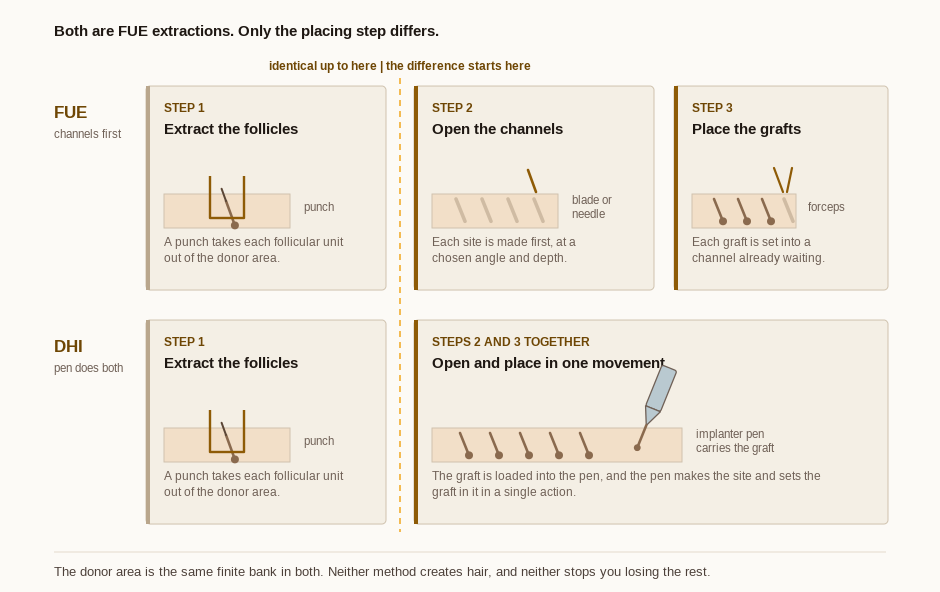
Both methods take the follicles out the same way. The question is only how they are put back.
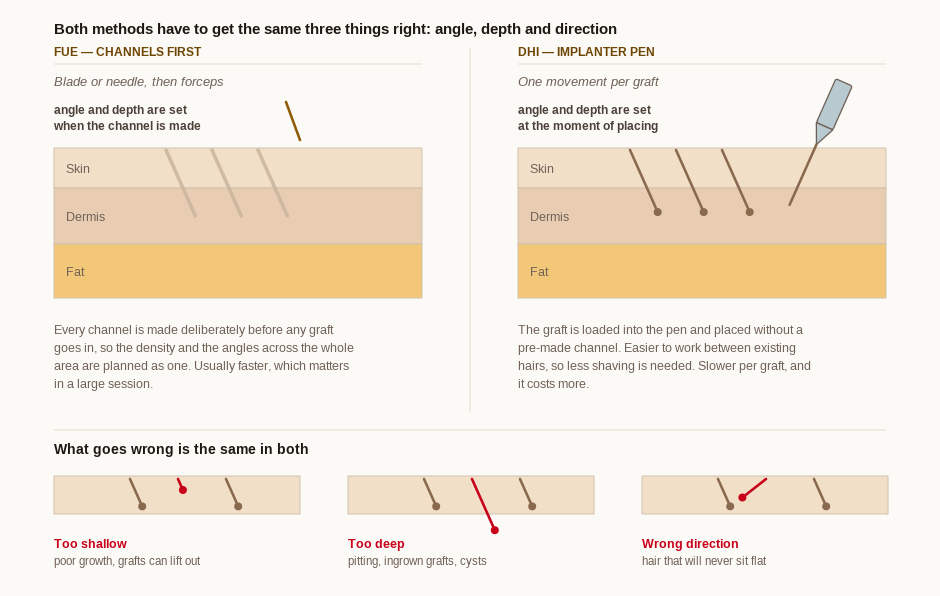
Neither method decides whether the result looks natural. Angle, depth and direction do, and those are the surgeon rather than the acronym. And before either: the number of grafts matters more than the method, because a transplant moves hair rather than making it — every graft placed at the front is one taken from a donor area that is finite.
- A large area, front to crownChannels opened first, grafts placed after. The established method for covering area. → FUE hair transplant £2,450 · 5 nights£1,700 treatment only
- A dense hairline, or placing between existing hairThe implanter places the graft in one step, which is the argument for it where existing hair must not be damaged. → DHI hair transplant £3,100 · 5 nights£2,350 treatment only
- I am a woman with thinning rather than a receding linePlanned differently, and the pattern matters more than the technique. → Hair loss in women £2,450 · 5 nights£1,700 treatment only
- I do not want my head shavedPossible, with its own limits on how much can be moved in one session. → Long hair transplant £2,950 · 5 nights£2,200 treatment only
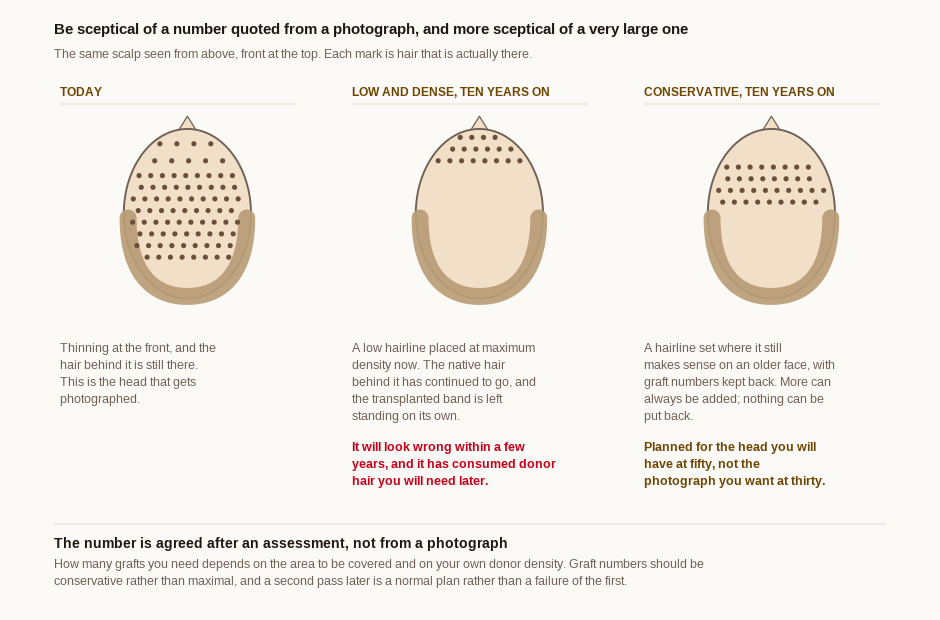
- I have been quoted a very large number of graftsThis page. Be sceptical of a number quoted from a photograph, and more sceptical of a very large one. Once donor grafts are used they are gone, and a low dense hairline placed today sits on a head that keeps changing.
| Treatment | Complete care price | Nights with us | Anaesthetic |
|---|---|---|---|
| FUE hair transplant | £2,450 · €2,940£1,700 · €2,040 treatment only | 5 nights | Local anaesthetic |
| DHI hair transplant | £3,100 · €3,720£2,350 · €2,820 treatment only | 5 nights | Local anaesthetic |
| Hair loss in women | £2,450 · €2,940£1,700 · €2,040 treatment only | 5 nights | Local anaesthetic |
| Long hair transplant | £2,950 · €3,540£2,200 · €2,640 treatment only | 5 nights | Local anaesthetic |
| Hair transplantThis page | On request | Not published | Not published |
Prices are the published complete-care figure unless marked otherwise, and a dash means we do not publish a single figure for that treatment — ask and we will tell you. Times and nights are typical, not promises.
FUE or DHI — the difference is one step, and it is not the one you are being sold
They are presented as two technologies at two prices. They are not. Both are FUE — both take the follicles out of the donor area the same way, one unit at a time. They differ in how the graft goes back in, and in nothing else.
1. Three steps, and the two methods are identical for the first one
The whole difference sits in the placing step.
2. What decides whether it looks natural, in either method
Angle, depth and direction — and all three are the hands, not the instrument.
So which should you ask for?
- Large bald area, big session.Channels first is usually the sensible answer. The area is being rebuilt from nothing, so there is no existing hair to work around, and the speed matters when several thousand grafts are going in.
- Thinning rather than bald, or a hairline being refined.The pen earns its extra cost here, because it places among hair you still have without shaving it off first.
- Long hair you do not want cut.A specific case, and the reason the long hair transplant page exists.
What should make you wary is a clinic that sells DHI as a better transplant rather than a different placing step, or that will not say who is doing the placing. In many high-volume clinics the surgeon opens the channels and technicians place the grafts — which is normal, and worth knowing rather than discovering.
The thing neither method changes
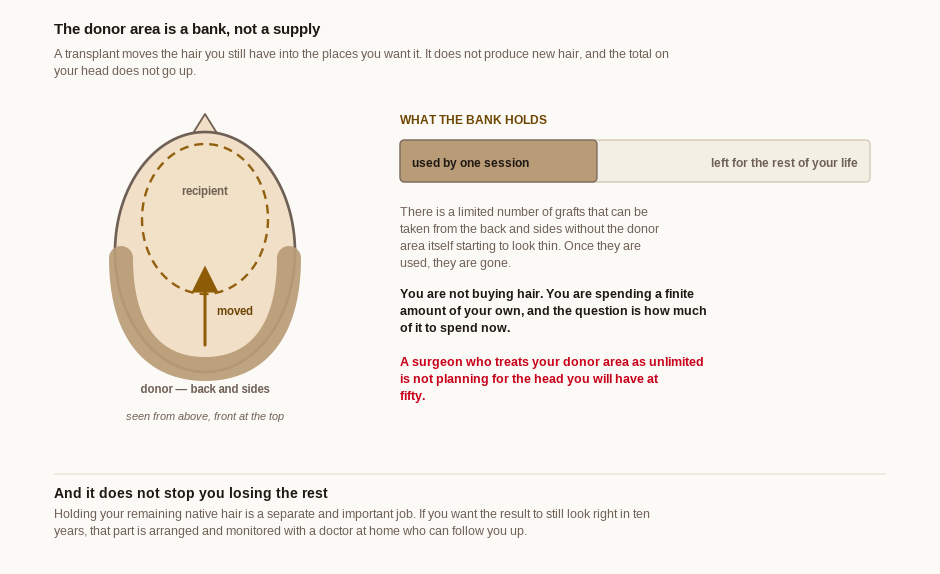
The donor area is a finite bank. A transplant moves hair you still have; it does not create new hair and it does not stop you losing the rest. Spending the bank too early, on a hairline drawn where it was at twenty, is the single most common regret in this field — and it cannot be undone by either technique.
Read the page for the one being proposed to you
- FUE hair transplant Channels opened first. The standard operation, and the right one for most larger sessions.
- DHI hair transplant Implanter pen. Real advantages in specific situations, and none at all in others.
- Long hair transplant Grafts transplanted without shaving, so you can see the result from the first day.
- Female hair restorationUsually diffuse thinning rather than a receding line, which changes what is appropriate.
- Hair PRPFor keeping what you have. Not a transplant, and not a substitute for one.
The number is the other half of this decision, and it is spent rather than bought
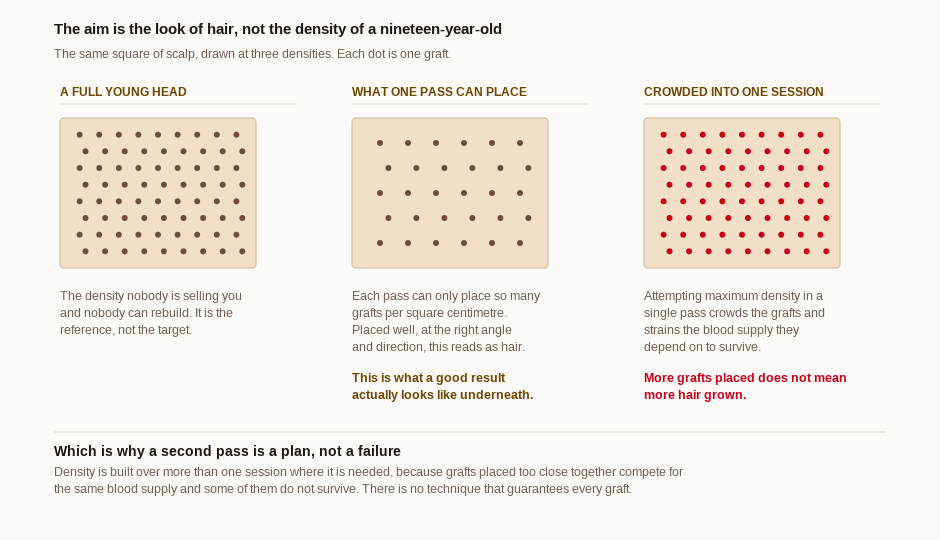
A transplant moves the hair you still have. It does not produce new hair, which means every graft placed at the front is one taken from the back — and there is a limit to how many can come out of there before the donor area itself starts to look thin.
4. The donor area is a bank, not a supply
You are not buying hair. You are spending a finite amount of your own.
5. What a low hairline costs you ten years on
Be sceptical of a number quoted from a photograph.
6. How dense a single pass can actually be
The aim is the look of hair, not the density of a nineteen-year-old.
What to ask before you accept a number
- How was it arrived at?It depends on the area to be covered and on your own donor density, and it is agreed in writing after an assessment — not from a photograph.
- What does it leave me?Ask what proportion of your donor area the plan uses, and what is left for a second pass in ten years.
- Where is the hairline going?A hairline that suits a face at thirty and a face at fifty are not the same line. The second one is the one to design for.
What is different about doing this with us
You do not recover in a hotel room
The week after surgery is spent at Mandarin Grove, our own retreat in Urla. Our team is there around the clock, and at the first doubt your surgeon is brought in rather than a stranger on duty.
About the retreatMeet the specialists in the UK first
Every three months we hold consultation meetings in UK cities, and have done for fifteen years. You can be seen in person, ask your questions, and decide afterwards — having booked nothing.
Upcoming datesThe same surgeon, months later
Our contracted surgeons have been with Revitalize for years. If a question comes up after you are home, you return to the same surgeon through the same team.
Contracted surgeonsWhat your quotation should itemise
A transplant is priced by the operation rather than by the graft, and we would rather you compared like with like. The published figure covers the procedure itself, the stay and the transfers; what varies is the size of the area and whether a second session is likely to be needed.
Be careful with per-graft pricing elsewhere. A low price per graft and an inflated graft count reach the same total by a different route, and the count is the one number nobody can verify afterwards.
- Clinical careThe named surgeon and facility, the procedure, anaesthesia, tests, hospital nights and planned reviews.
- StayNights at the retreat, the room arrangement and which meals are included.
- TransfersWhich airport, hospital and clinic journeys are covered.
- AftercareClinical checks, dressing or suture appointments, medicines, and how to reach the team once you are home.
- Charged separatelyFlights, insurance, a companion's costs, extra nights and changes to travel dates.
| Treatment | Complete care price | Nights with us | Anaesthetic | In theatre |
|---|---|---|---|---|
| FUE hair transplant | £2,450 · €2,940£1,700 · €2,040 treatment only | 5 nights | Local anaesthetic | roughly six to eight hours |
| DHI hair transplant | £3,100 · €3,720£2,350 · €2,820 treatment only | 5 nights | Local anaesthetic | roughly six to eight hours |
| Long hair transplant | £2,950 · €3,540£2,200 · €2,640 treatment only | 5 nights | Local anaesthetic | Not published |
| Hair loss in women | £2,450 · €2,940£1,700 · €2,040 treatment only | 5 nights | Local anaesthetic | Not published |
| Beard transplant | £2,800 · €3,360£2,050 · €2,460 treatment only | 5 nights | Local anaesthetic | four to seven hours |
| Eyebrow transplant | £2,450 · €2,940£1,700 · €2,040 treatment only | 5 nights | Local anaesthetic | three to five hours |
| Eyelash transplant | £2,450 · €2,940£1,700 · €2,040 treatment only | 5 nights | Local anaesthetic | three to four hours |
| Hair PRP | On request | Day case | Sedation | Not published |
Prices are the published complete-care figure unless marked otherwise, and a dash means we do not publish a single figure for that treatment — ask and we will tell you. Times and nights are typical, not promises.
See the published price list — indicative figures only; the one that applies to you is in your written plan. If you are holding a UK quotation, this is what actually differs.
If the result needs more work
A complication. Surgical treatment is guaranteed for one year from the date of treatment. The guarantee covers medical complications and any revision that becomes clinically necessary as a result; the treatment itself is carried out in İzmir at no charge. Full terms and exclusions.
A second stage. Separately, and more commonly: how far one operation can take you depends on your tissue as much as on the surgeon. Skin thickness and elasticity, age, weight changes, smoking and healing set a ceiling, and you only see where yours was once swelling settles. Where a second stage would meaningfully improve the result, it is priced at cost rather than at the original price — not as a remedy for something going wrong, but because one operation does not always reach the maximum.
We would rather say that before you book than afterwards.
Patients who had this, in their own words
How the process works
Free online consultation
You describe the problem. We pass it to the surgeon for preliminary review.
Written plan
Named surgeon, named hospital, proposed procedure and an itemised total — before you book anything.
Assessment in İzmir
Health checks, tests and an in-person meeting with your surgeon. Final approval happens here.
Surgery and hospital stay
Monitored recovery and nursing support.
Recovery and going home
Your stay at the retreat, review appointments, clearance to fly, and a route back to your surgeon afterwards.
Our treatment process · Recovery and aftercare · Contracted hospitals · Reviews and UK press
Questions people ask
Will a transplant give me more hair?
It will give you hair where there is none now, by moving it from where there is plenty. The total amount of hair on your head does not increase. This is the single most important thing to understand before booking.
How many grafts do I need?
That is the wrong question to start with. The right one is whether your donor area can cover the area you want covered — now, and once the loss that is still happening has continued. A surgeon answers this from photographs and an examination, not from a price list.
Will the transplanted hair fall out?
The transplanted follicles keep the character of where they came from and are generally not lost to pattern baldness. The hair around them can continue to thin, though, which is why planning for the long term matters more than maximising the first session.
When does it start to look normal?
The transplanted hairs shed within weeks — this is expected and alarms people who were not warned. Regrowth starts at around three to four months, and the result is judged at twelve.
Can hair loss be treated without surgery?
Sometimes, and it should be looked at first. Medical treatment can slow or partly reverse early loss, and in women a transplant is often not the right answer at all until a thyroid, iron or hormonal cause has been ruled out.
Send us photographs
For hair, photographs do most of the work: the front, the crown, and the back of your head in daylight. From those a surgeon can tell you whether your donor area supports what you want, and roughly what to expect.
The consultation is free and nothing is booked at this stage.
Before any of this, you can meet the surgeon in person. We hold free consultations in British cities every three months — next in London on 9 January and Manchester on 10 January. If we are not near you, say so and we will tell you when we are.
The information on this page is general and does not replace an individual assessment by the treating surgeon. It is not medical advice, diagnosis or treatment. Individual results vary.