
How Smoking Affects Surgery Recovery
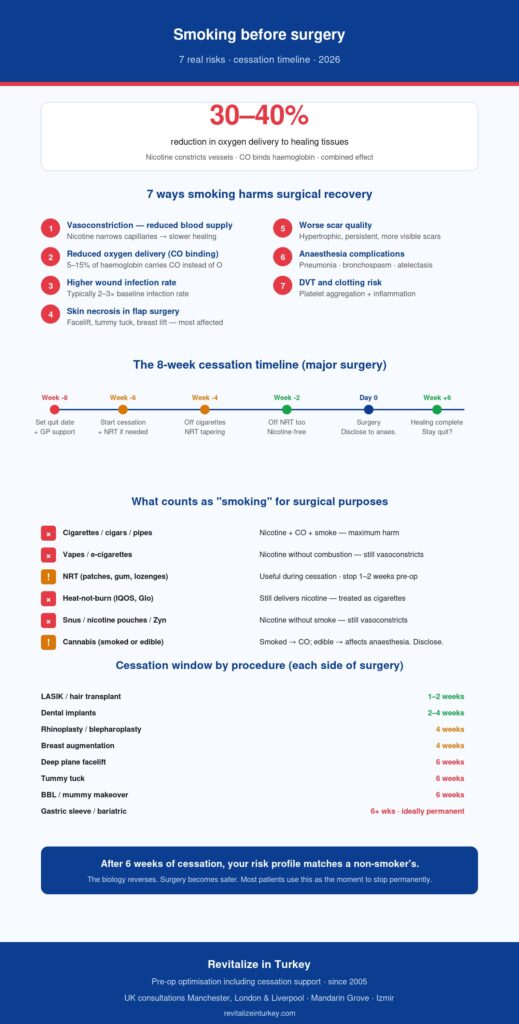
Smoking before surgery is the single biggest modifiable risk factor in elective surgical recovery. No other patient-controlled variable affects complication rates and outcome quality as consistently. The mechanism is biological, not moral: nicotine constricts small blood vessels, carbon monoxide displaces oxygen on red blood cells, and the combined effect can reduce oxygen delivery to healing tissues by 30–40%. This guide explains the 7 evidence-based ways smoking affects surgery recovery, how long surgeons require you to stop, what counts as “smoking” (cigarettes, vaping, nicotine replacement, cannabis), and how smokers can become surgical candidates through structured cessation. The framework draws on guidance from NHS Smokefree, the Association of Anaesthetists, NICE, BAAPS and Royal College of Surgeons consensus on pre-operative smoking cessation.
If you smoke, this article is not designed to make you feel bad. It’s designed to explain what surgeons actually know about smoking and surgery — and what cessation protocols can do to bring your risk profile down to non-smoker levels in 4–6 weeks. Most smokers who need elective surgery successfully stop with structured support; most surgeons consider them clinically equivalent to lifelong non-smokers within weeks of cessation.
Table of contents
- The short answer
- The biology: why nicotine and smoke harm healing
- Risk 1: Reduced blood supply (vasoconstriction)
- Risk 2: Reduced oxygen delivery
- Risk 3: Higher wound infection rate
- Smoking before surgery — 7-effect infographic
- Risk 4: Skin necrosis in flap surgeries
- Risk 5: Hypertrophic and keloid scarring
- Risk 6: Anaesthesia complications
- Risk 7: DVT and clotting effects
- What counts as “smoking”? Vaping, NRT, cannabis
- How long to stop smoking before surgery
- The standard cessation protocol
- What if I can’t fully stop?
- Smoking and surgery — by procedure
- Frequently asked questions
- What to do next
The short answer
Smoking before surgery raises the risk of every major surgical complication — wound infection, skin necrosis, blood clots, anaesthesia events, hypertrophic scarring — by mechanisms that are well-established. Nicotine constricts blood vessels and reduces tissue oxygen delivery by 30–40%. Carbon monoxide displaces oxygen on red blood cells. Together they impair every stage of wound healing. The standard requirement is to stop all nicotine (cigarettes, vaping, replacement therapy) for at least 4 weeks before and 4 weeks after surgery — 6 weeks each side for procedures with long incisions or skin flaps (facelift, tummy tuck, breast lift). Most smokers who comply have outcomes comparable to non-smokers. Smokers who don’t can be in the worst third of the bell curve regardless of how good the surgery itself was.
The biology: why nicotine and smoke harm healing
Cigarette smoke contains over 7,000 chemicals; for surgical recovery, two matter most:
- Nicotine is a potent vasoconstrictor — it makes small blood vessels narrow. Healing tissues depend on capillary blood supply for oxygen and nutrients. Vasoconstriction directly impairs this.
- Carbon monoxide binds to haemoglobin 200 times more strongly than oxygen does. In a smoker, a meaningful fraction of red blood cells are carrying CO instead of oxygen. Even with normal blood flow, less oxygen reaches the tissues.
Combined, these two effects can reduce the oxygen reaching a healing wound by 30–40%. Wound healing is an oxygen-intensive process — collagen synthesis, immune cell function, and new blood vessel formation all require it. Lower oxygen delivery means slower healing, weaker scars, higher infection rates, and more wound breakdown.
Other smoke components contribute too — particulates, tar, oxidising compounds — but the nicotine + CO mechanism is the dominant pathway. This is why nicotine-only products (vaping, replacement therapy) still cause surgical harm, even without the smoke.
Risk 1: Reduced blood supply (vasoconstriction)
What happens
Nicotine narrows small arteries and arterioles within minutes of exposure. The effect persists for several hours after each cigarette, vape or NRT dose. In a regular smoker, the cumulative effect is chronic capillary vasoconstriction in the skin and subcutaneous tissues.Surgical consequence. Healing tissues — wound edges, skin flaps, fat grafts — depend on capillary supply. Reduced supply means slower healing, higher infection risk, and risk of tissue death (necrosis) in skin flaps. This is the dominant mechanism behind smoking’s surgical harm.
Risk 2: Reduced oxygen delivery
What happens
Carbon monoxide binds haemoglobin 200× more tightly than oxygen. In an active smoker, 5–15% of haemoglobin can be bound by CO at any time. CO is also released for hours after each cigarette as it slowly clears.Surgical consequence. Even healthy-looking blood is carrying less oxygen. Wound oxygen tension is reduced, immune function is impaired, and collagen synthesis slows. The effect compounds with vasoconstriction — less blood, carrying less oxygen, reaching tissues that need both.
Risk 3: Higher wound infection rate
What happens
Smokers have substantially higher surgical site infection rates than non-smokers across multiple procedure types — published meta-analyses commonly cite 2–3× the baseline rate for clean elective surgery. The mechanisms are: impaired neutrophil function in low-oxygen tissue, reduced antibody response, slower wound closure (longer exposure window), and reduced microcirculation (so antibiotics reach the wound less effectively).Surgical consequence. Higher antibiotic use, longer recovery, higher revision rates, and in some cases conversion of minor infections into major ones requiring return to theatre.
Risk 4: Skin necrosis in flap surgeries
What happens
Some cosmetic procedures involve raising and re-positioning skin flaps — facelift, tummy tuck, breast lift, mastopexy, body lift. These flaps depend on residual blood supply from the small vessels not cut during surgery. In smokers, this already-reduced supply can be insufficient, and the edges of the flap can die — a complication called skin necrosis.Surgical consequence. Skin necrosis in a facelift means visible scars and possible deformity. In a tummy tuck it can mean wound breakdown, prolonged dressing changes, and revision surgery. This is the single most documented procedure-specific harm of smoking, and the reason many surgeons categorically decline current smokers for these procedures.
Risk 5: Hypertrophic and keloid scarring
What happens
Wound healing in nicotine-impaired tissue produces poorer-quality scars. Collagen organisation is disorganised; the wound stays inflamed longer; and the final scar is more often hypertrophic (raised and red) or persistent rather than thin and pale.Surgical consequence. The aesthetic outcome of cosmetic surgery is partly determined by scar quality at 12 months. Smokers more often end up with visible, persistent scars even when the operation itself was technically excellent. Scar revision rates are higher in smokers.
Risk 6: Anaesthesia complications
What happens
Smokers have higher rates of: post-operative pneumonia, atelectasis (partial lung collapse), bronchospasm, and prolonged need for oxygen support after surgery. The mechanisms include irritated airways, impaired mucociliary clearance (so secretions accumulate), and reduced pulmonary reserve.Surgical consequence. Slower recovery from anaesthesia, higher rates of respiratory complications in the first 48 hours, and greater need for chest physiotherapy and oxygen support. Anaesthesia is generally safe in smokers in accredited hospitals, but the risk profile is genuinely higher.
Risk 7: DVT and clotting effects
What happens
Smoking affects platelet function and the clotting cascade — increasing platelet aggregation and creating a more thrombogenic environment. Combined with the inflammatory effects of surgery itself, this raises the risk of deep vein thrombosis and pulmonary embolism.Surgical consequence. Higher VTE risk, particularly in procedures already associated with this risk (tummy tuck, gastric sleeve, mummy makeover). Smokers may receive more aggressive anticoagulant prophylaxis as a result.
What counts as “smoking”? Vaping, NRT, cannabis
For surgical safety, the relevant question is “what’s the nicotine and CO exposure?” Different products contribute different combinations:
- Cigarettes. Nicotine + carbon monoxide + smoke particulates + tar. Maximum surgical harm.
- Cigars and pipes. Similar mechanism to cigarettes. Same restrictions apply.
- Vapes and e-cigarettes. Nicotine without combustion, so no CO. But nicotine alone still causes vasoconstriction. Most surgeons require vaping to stop along with cigarettes during the cessation window.
- Nicotine replacement therapy (patches, gum, lozenges, sprays). Nicotine without smoke. Same vasoconstriction risk as vaping. Generally needs to stop 1–2 weeks before surgery. Used short-term during initial cessation, then stopped pre-op.
- Heat-not-burn products (IQOS, Glo). Heated tobacco produces less CO than combustion cigarettes but still delivers nicotine. Treated like vaping or cigarettes by most surgeons.
- Cannabis smoking. Combustion produces CO. Cannabinoids also affect anaesthesia and post-op pain perception. Most anaesthesiologists request honest disclosure and cessation as for cigarettes.
- Cannabis edibles or oils. No smoke, no nicotine. But cannabinoids still affect anaesthesia and platelet function — disclose to your anaesthesiologist.
- Snus, chewing tobacco, nicotine pouches (e.g. Zyn). Nicotine without smoke. Same vasoconstriction risk; same cessation requirement.
The principle: if it contains nicotine, it counts. If it involves combustion, it counts double. For surgery purposes, “I quit cigarettes but I vape” is not stopping smoking — it’s switching nicotine delivery.
How long to stop smoking before surgery
Published consensus and most surgical society guidance converges on the following framework:
| Period | Recommendation |
|---|---|
| For day-case procedures with low flap risk (LASIK, hair transplant, simple dental) | Stop nicotine 1–2 weeks pre-op and 1–2 weeks post-op |
| For moderate surgery (rhinoplasty, blepharoplasty, breast augmentation) | Stop nicotine 4 weeks pre-op and 4 weeks post-op |
| For major surgery with skin flaps (deep plane facelift, tummy tuck, breast lift, mummy makeover, BBL) | Stop nicotine 6 weeks pre-op and 6 weeks post-op |
| For bariatric surgery (gastric sleeve, bypass) | Stop nicotine 6+ weeks pre-op; ideally permanently |
The reason for the long window: it takes about 4–6 weeks for the chronic effects of nicotine on small vessels to fully reverse. Patients who stop the day before surgery have nicotine clearance overnight, but the underlying vasomotor function takes weeks to recover. Surgeons schedule around the underlying biology, not the patient’s last cigarette.
The standard cessation protocol
Week -8 to -6: Plan and start
Set a quit date. Engage with your GP for prescription support if needed (varenicline, bupropion). Consider NRT — patches, gum, inhalers — for the first 2–3 weeks of cessation. Identify triggers and avoidance strategies. NHS Smokefree, Better Health and similar programmes offer free structured support.
Week -6 to -2: Maintain cessation; transition off NRT
By week 2 of cessation, vasomotor function is improving substantially. By week 4, capillary function is approaching normal. NRT can be tapered. Stay off all combustion products entirely.
Week -2 to 0: Off all nicotine
NRT stopped at least 1–2 weeks before surgery. No vaping, no patches, no gum. Cumulative pre-op cessation: 6 weeks for major surgery.
Day 0 — Surgery
Honest disclosure to anaesthesiologist about cessation status. Even brief recent exposure should be reported; the team may adjust the anaesthetic plan.
Week 1 to 6 post-op
No nicotine in any form. This is when wound healing peaks. Restarting smoking now compromises every part of the result you’ve paid for.
Week 6+ post-op
Many patients who reach 6 weeks of cessation around surgery never restart. The surgical milestone is often the easiest moment to permanently stop smoking. For bariatric patients, permanent cessation is part of the long-term protocol.
What if I can’t fully stop?
For some patients, complete cessation in the available timeframe is unrealistic. Honest discussion with your surgeon is more useful than concealment. Three pathways exist:
- Reduced consumption. Even cutting from 20/day to 5/day reduces some risk, though not all. For day-case procedures this may be acceptable; for major flap surgery it usually isn’t.
- Delayed surgery. Push the booking date out 3–6 months and use the time for structured cessation with full GP support, varenicline or bupropion prescription, and accountability. Most patients who try this succeed.
- Procedure modification. Some surgeons offer modified techniques (smaller incisions, less undermining) for patients who cannot fully stop. The result is typically less complete than the standard procedure.
What doesn’t work: lying about smoking status. Anaesthesiologists can sometimes detect recent nicotine use clinically; saliva cotinine testing can detect it definitively. Patients who conceal smoking and have a complication have a much worse experience than those who disclose and either modify or delay surgery.
Smoking and surgery — by procedure
| 程序 | Cessation requirement | Notes |
|---|---|---|
| LASIK / SMILE laser eye | 1–2 weeks recommended | Lower flap-risk procedure |
| Hair transplant | 2 weeks pre & post | Affects graft survival in donor and recipient areas |
| Dental implants | 2–4 weeks pre & post | Implant osseointegration significantly impaired by smoking |
| Blepharoplasty | 4 weeks pre & post | Lower risk than face-flap surgery but still skin-edge healing |
| 隆鼻术 | 4 weeks pre & post | Affects scar quality and graft survival in revision cases |
| Breast augmentation | 4 weeks pre & post | Capsular contracture rates higher in smokers |
| Mini facelift | 6 weeks pre & post | Skin flap risk |
| Deep plane facelift | 6 weeks pre & post — many surgeons decline current smokers | Highest flap-risk facial procedure |
| Breast lift / reduction | 6 weeks pre & post | Pedicle flap survival depends on blood supply |
| Tummy tuck | 6 weeks pre & post — many surgeons decline current smokers | Skin necrosis at the lower abdominal flap is well-documented |
| BBL | 6 weeks pre & post | Fat graft survival depends on local oxygen delivery |
| Mummy makeover | 6 weeks pre & post — many surgeons decline current smokers | Combination procedure compounds risk |
| Gastric sleeve / bariatric | 6+ weeks; ideally permanent | Long-term smoking compromises bariatric outcomes |
Frequently asked questions
How long should I stop smoking before cosmetic surgery?
4 weeks pre-op and 4 weeks post-op for most procedures; 6 weeks each side for procedures involving skin flaps or long incisions (deep plane facelift, tummy tuck, breast lift, mummy makeover, BBL). For day-case procedures (LASIK, hair transplant), 1–2 weeks. For bariatric surgery, 6+ weeks and ideally permanent.
Does vaping count as smoking for surgery?
Yes, for surgical purposes. Vaping delivers nicotine without combustion, but nicotine alone is enough to cause vasoconstriction and impair wound healing. Most surgeons require vaping to stop along with cigarettes during the cessation window.
Can I use nicotine replacement therapy before surgery?
NRT (patches, gum, lozenges) is useful during the first 2–3 weeks of cessation. It should be tapered down and stopped at least 1–2 weeks before surgery so the patient enters surgery completely nicotine-free.
What happens if I lie about smoking?
Concealing smoking status puts you at avoidable risk. Anaesthesiologists can sometimes detect recent nicotine use clinically; saliva cotinine testing is available. More importantly, if a complication occurs, the team won’t know the relevant risk factor. Honest disclosure is always the right answer — surgeons can modify plans or delay surgery as needed.
Do social smokers (1–2 per week) need to stop?
Yes. Any nicotine exposure within the 4–6 weeks before surgery affects vasomotor function. Even occasional smoking should stop for the full pre-op period for any procedure beyond simple day-case surgery.
What about cannabis before surgery?
Smoked cannabis produces carbon monoxide and should be stopped like cigarettes. Edible cannabis doesn’t produce CO, but cannabinoids still affect anaesthesia, pain perception and platelet function. Always disclose cannabis use (any form) to your anaesthesiologist.
Why are some surgeons stricter than others?
The strict surgeons are usually those who have seen the worst complications. Skin necrosis after facelift in a smoker, tummy tuck wound breakdown, BBL fat graft loss — these are memorable events that make surgeons categorically decline current smokers. The strictness is clinical caution, not moralism.
If I stop for 4 weeks, do I have non-smoker outcomes?
Largely yes. The biological effects of nicotine on small vessels reverse substantially over 4 weeks; by 6 weeks, capillary function is essentially restored. Most surgeons consider patients clinically non-smoking after 6 weeks of cessation. The long-term lung effects of years of smoking are slower to reverse, but for elective cosmetic surgery purposes, the 4–6 week window matters most.
Can I start smoking again after the post-op window?
Many patients use the surgery as motivation to quit permanently. Restarting after 4–6 weeks of cessation is clinically possible but undermines the cardiovascular and respiratory benefits achieved during the cessation period. Surgeons typically encourage permanent cessation, both for health reasons and for the longevity of the surgical result (skin quality, scar appearance, and longevity of facelift results are all smoking-sensitive).
What support is available to stop smoking before surgery?
UK NHS Smokefree, Better Health Quit Smoking, and local stop-smoking services offer free structured support including NRT, behavioural support, and group sessions. GPs can prescribe varenicline (Champix) and bupropion (Zyban) where appropriate. The success rate of structured cessation is substantially higher than going it alone.
What to do next
If you smoke and want to have surgery in Turkey, the most productive next step is starting cessation now — even before your consultation. The clinical timeline of cessation is independent of the booking timeline, and getting a head-start makes you a better candidate sooner. Revitalize in Turkey’s UK consultations in Manchester, London and Liverpool include candidate assessment that takes smoking status into account; surgery dates are usually set 8–12 weeks out specifically so cessation is complete before theatre.
- Book a free UK consultation
- How surgeons assess surgical candidates
- Why BMI matters before surgery
- What medical clearance involves
- See our end-to-end treatment process
- Tour the Mandarin Grove Recovery Retreat
Continue reading our medical tourism in Turkey cluster
- Complete Guide to Medical Tourism in Turkey
- How Recovery Affects Final Results
- Understanding Surgical Risks
- 25 Questions to Ask Before Cosmetic Surgery
- How to Choose a Safe Clinic in Turkey
- What to Expect When Travelling to Turkey for Surgery
About the author
[Author name], medical content writer specialising in pre-operative optimisation and surgical patient safety.
Medically reviewed by
Dr. [Surgeon name], [Specialty], Turkish Ministry of Health Registration No. [XXXX]. Member of the Turkish Society of Plastic, Reconstructive and Aesthetic Surgeons (TSPRAS).
Last reviewed: 26 May 2026.
This article is for general patient information and does not constitute medical advice. Smoking cessation should be undertaken with GP support where prescription medications (varenicline, bupropion) are considered. Always consult a licensed medical professional for personalised guidance.

 English
  Afrikaans
  Albanian
  Russian
  German
  Swedish
  Spanish
  Romanian
  Portuguese
  Japanese
  Azerbaijani
  Chinese
  Dutch
Dutch  French
  German (Formal)
  Greek
Greek