
Weight Loss After Facelift: What Happens to Your Result and How to Protect It (2026 UK Guide)
Weight loss after facelift is the single most-asked question we now hear from patients in the GLP-1 era. A modest 2–4 kg loss after surgery is normal and rarely a problem. A 10 kg or 20 kg loss — particularly when driven by semaglutide (Ozempic, Wegovy) or tirzepatide (Mounjaro) — can soften your facelift result, recreate jowl laxity, hollow the cheeks, and in some cases call for a revision. This 2026 guide explains how much weight you can safely lose after a facelift, what changes to expect at different ranges, when revision is appropriate, and the concrete steps that protect the result you paid for.On this page
- Why weight loss after a facelift matters
- Small weight loss: under 5 kg
- Moderate weight loss: 5–10 kg
- Significant weight loss: 10 kg or more
- The “Ozempic face” effect after a facelift
- When a revision facelift is appropriate
- How to protect your facelift result
- Best-practice weight loss timing
- Pyetje të shpeshta
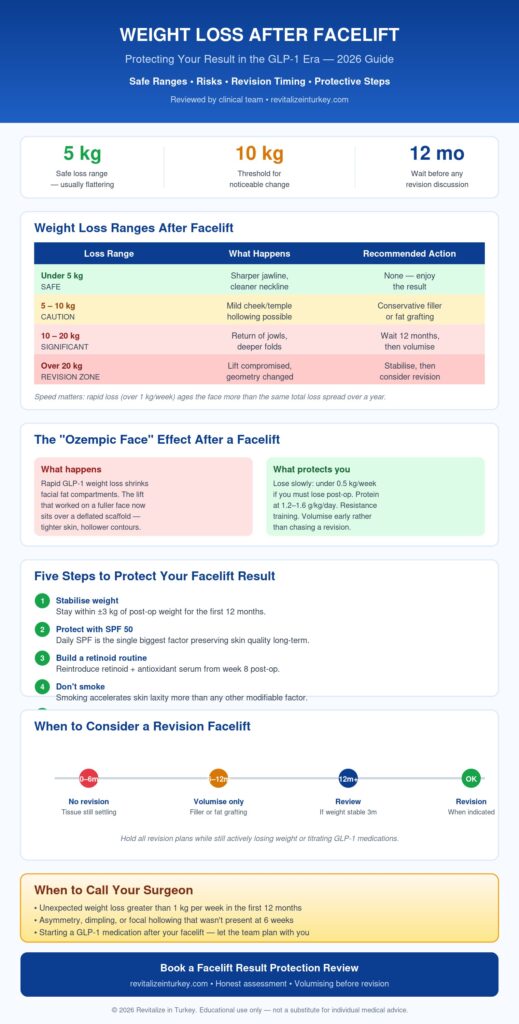
Why weight loss after a facelift matters
A facelift removes redundant skin and repositions the deeper SMAS (superficial musculoaponeurotic system) layer. The result is calibrated to the volume of fat and soft tissue present at the time of surgery. When fat volume changes substantially afterwards, the geometry your surgeon set changes too. Skin that was perfectly redraped over a fuller face can become slightly loose again if the underlying support pad shrinks. The midface, jawline and neckline are the three zones most sensitive to post-operative weight loss because they sit on fat compartments that respond strongly to overall body weight.
Small losses are not just safe — they often improve the result, sharpening the jawline definition. Bigger losses, especially fast ones, can reverse some of the surgical gain. The British Association of Aesthetic Plastic Surgeons (BAAPS) and the International Society of Aesthetic Plastic Surgery (ISAPS) both now publish guidance recommending weight stability before dhe after major facial procedures.
Small weight loss: under 5 kg
Losing up to 5 kg in the year after a facelift is generally a non-issue and frequently flattering. Patients often drop 2–4 kg in the first six weeks simply because of reduced appetite, swelling-related fluid shifts and a quieter social calendar during recovery. This range usually:
- Sharpens the jawline that surgery has already redefined.
- Improves the neckline contour without compromising skin tension.
- Has no effect on long-term durability of the lift.
Bottom line: a loss of up to 5 kg after a facelift typically improves rather than harms the result, provided it happens gradually over 3–6 months.
Moderate weight loss: 5–10 kg
Losses in the 5–10 kg range begin to show on the face, and the picture is mixed. The benefit is a cleaner jawline; the cost is some volume loss in the cheeks and temples that can age the face mildly, even though the lift itself is still doing its job. Patients in this range usually do not need a revision, but a small volumising step — fat grafting or a conservative dermal filler programme — often restores the youthful midface fullness and protects the long-term result.
| Effect | What you may notice | Typical fix |
|---|---|---|
| Sharper jawline | Crisper transition from cheek to neck | None — this is a positive |
| Mild cheek hollowing | Slight loss of mid-cheek fullness | Fat grafting or filler at 12 months |
| Temple narrowing | “Tired” upper face appearance | Filler in the temples |
| Subtle skin laxity | A little softness returning at the jawline | Watch and wait, or RF skin tightening |
Significant weight loss: 10 kg or more
This is where weight loss after facelift becomes a genuine surgical concern, especially when the loss is rapid (greater than 1 kg per week) or driven by GLP-1 medications. Above 10 kg, the facial fat compartments shrink enough that the lift is no longer working with the same anatomy your surgeon operated on. Expect to see:
- Return of jowl laxity as the skin envelope becomes loose again over a smaller pad.
- Pronounced cheek and temple hollowing — the “Ozempic face” look superimposed on a facelift result.
- Deeper nasolabial folds and marionette lines because the volume that held them open has gone.
- Skin quality changes — thinner, crepier skin that creases more visibly.
Important: if you have started or are planning a GLP-1 weight-loss programme after a facelift, tell your surgeon. The decision to wait, to volumise, or to plan a future revision is much easier when it is made early rather than after 20 kg of unplanned loss.
The “Ozempic face” effect after a facelift
“Ozempic face” is the colloquial term for the gaunt, hollowed appearance that follows rapid GLP-1 weight loss in the face. It is not a side effect of the drug itself — it is the same volume loss any rapid weight reduction would produce, simply made far more common by widespread GLP-1 use. When this happens after a facelift, the patient often gets the worst of both worlds: a tighter skin envelope but a deflated underlying scaffold.
If you have read our companion piece on Ozempic before facelift, the same logic applies in reverse here. Weight needs to be stable for at least 3 months in either direction of the operation to keep results predictable. Started GLP-1s after your lift? Aim for slow, controlled loss — around 0.5 kg per week — and check in with your surgeon at the 3, 6 and 12-month marks.
When a revision facelift is appropriate
A revision is rarely needed for losses under 10 kg, and is rarely worthwhile in the first year regardless of how much weight has been lost. Tissue continues to settle and contract for 9–12 months after a facelift, and what looks like recurrent laxity at month 3 often resolves by month 9. The honest consenting position is:
| Time since lift | Weight change | Recommended action |
|---|---|---|
| 0–6 months | Any | No revision. Optimise nutrition, monitor. |
| 6–12 months | Under 10 kg | No revision. Consider conservative filler/fat grafting. |
| 6–12 months | Over 10 kg, still losing | Hold. Wait for weight to stabilise for 3 months. |
| 12+ months | Weight stable, significant laxity | Formal revision consultation appropriate. |
| Any | Active GLP-1 use, still titrating | Hold all revision plans until dose and weight settle. |
How to protect your facelift result
Most of the protective work happens in everyday habits rather than in clinic. The patients whose facelifts age most gracefully tend to share five characteristics: stable weight, generous sun protection, structured skincare, no smoking, and a willingness to top up volume rather than chase another surgical procedure too soon.
Maintain stable weight (within ±3 kg)
If you must lose weight for health reasons after surgery, aim for a slow rate — 0.5 kg per week is the established sweet spot. Crash diets and aggressive GLP-1 titration produce the worst cosmetic outcomes.
Prioritise protein and resistance training
Muscle preservation during weight loss reduces overall fat-pad shrinkage and helps the face hold its scaffolding. Aim for 1.2–1.6 g of protein per kilogram of body weight per day during any active weight-loss phase.
Use sunscreen daily
UV damage is the single biggest accelerator of skin laxity after a facelift. SPF 50 every morning, regardless of weather, is the most cost-effective long-term result protector that exists.
Build a sensible skincare routine
A retinoid at night, an antioxidant serum in the morning and a hydrating moisturiser will preserve skin quality far better than any expensive in-clinic device. Wait at least 8 weeks post-op before reintroducing retinoids.
Volumise before re-cutting
If you have lost 5–10 kg and feel your face looks tired, a conservative fat-grafting or filler programme almost always outperforms a revision facelift in this window — lower risk, faster recovery, more predictable result.
Best-practice weight loss timing around a facelift
The cleanest sequence for any patient considering both a facelift and weight loss in the same 24-month window is:
- Reach your target weight first. Lose what you intend to lose before the facelift.
- Stabilise for 3–6 months. Weight that has not moved by more than ±2 kg for three consecutive months counts as stable.
- Pause GLP-1 medications at least 7 days before surgery per the American Society of Anesthesiologists’ 2023 guidance (ASA). Disclose all use to the anaesthetic team.
- Recover for 12 months. Do not start aggressive weight loss in the first year post-op.
- If further loss is medically indicated, restart slowly and keep the rate under 1 kg per week.
This sequence is summarised in our companion guides on Wegovy and cosmetic surgery dhe why BMI matters before surgery.
Pyetje të shpeshta
Will losing 5 kg ruin my facelift?
No. A 5 kg loss almost always improves the result by sharpening the jawline and neckline. Concerns begin around 10 kg and grow with the speed of loss.
Can I start Ozempic or Wegovy after my facelift?
Yes, but only after discussing it with your surgeon. Aim for a slow loss rate (around 0.5 kg per week) and check in at 3, 6 and 12 months so volumising steps can be planned if needed.
How long should I wait before considering a revision?
Most surgeons will not consider a revision in the first 12 months. Tissue continues to settle, and what looks like recurrent laxity often resolves on its own.
Is fat grafting better than filler for “Ozempic face” after a facelift?
Both work. Fat grafting is more durable but requires a small additional procedure; filler is reversible and quicker but needs maintenance every 12–18 months. The right answer depends on how much volume needs to be restored and your tolerance for repeat treatments.
Does the type of facelift affect how it responds to weight loss?
Yes. Deep-plane and extended SMAS techniques generally tolerate weight changes better than skin-only lifts because they reposition the deeper structural layer and don’t rely solely on skin tension.
Will a healthy diet alone preserve my result?
Diet is one part of a five-factor formula — weight stability, sun protection, skincare, no smoking, and sensible volume top-ups. Any single factor done well helps; doing all five protects the result for a decade or more.
Related reading
- Facelift Recovery Day By Day
- Ozempic Before Facelift
- Wegovy and Cosmetic Surgery
- Neck Lift Recovery Timeline
- How Recovery Affects Final Results
- Why BMI Matters Before Surgery
- Mounjaro Before Tummy Tuck
- How Smoking Affects Surgery Recovery
Reviewed by the Revitalize in Turkey clinical team. Our medical reviewer is a consultant plastic surgeon registered with the Turkish Society of Plastic, Reconstructive and Aesthetic Surgeons (TSPRAS). Content is updated to reflect 2026 ASA, BAAPS and ISAPS guidance on GLP-1 medications and facial surgery.
Disclaimer. This article is for general education only. It is not a substitute for individual medical advice. Cosmetic surgery decisions, weight-loss medication use and revision timing should always be made with your operating surgeon and prescribing doctor, who know your full medical history.


 English
  Afrikaans
  Albanian
  Russian
  German
  Swedish
  Spanish
  Romanian
  Portuguese
  Japanese
  Azerbaijani
  Chinese
  Dutch
Dutch  French
  German (Formal)
  Greek
Greek