
Eyelid Surgery Recovery Stages
Eyelid surgery recovery (blepharoplasty) is one of the gentler cosmetic procedure recoveries — but it’s also one where eye-specific aftercare matters more than for any other facial surgery, because the operation is on the eye itself. The honest version: visible recovery for upper blepharoplasty is around 7–10 days; lower blepharoplasty takes a little longer at 10–14 days. The final result emerges over 3–6 months as residual swelling settles and scars mature in the natural creases. This guide walks through the eyelid surgery recovery stages day by day, explains what’s different between upper, lower and combined procedures, covers the eye-specific aftercare (drops, no contacts, sun protection) and helps you plan time off, time before being seen, and when the final result actually settles.
Most blepharoplasty patients describe the recovery as much easier than they expected — but the eyes look “operated on” for the first 7–10 days, which is what drives the time-off-work conversation. Realistic expectations are the strongest predictor of patient satisfaction. Information here is consistent with NHS, BAAPS and Royal College of Ophthalmologists guidance.
Table of contents
- The short answer
- Upper vs lower vs combined — quick orientation
- Day 0 — surgery day
- Day 1
- Days 2–3
- Days 4–7
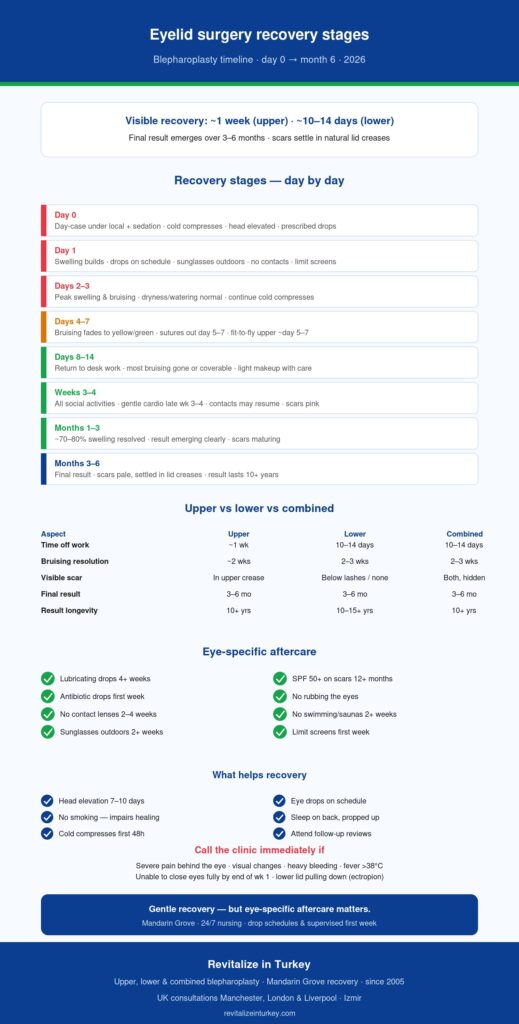
- Eyelid surgery recovery stages — infographic
- Days 8–14
- Weeks 3–4
- Months 1–3
- Months 3–6 — final result
- Upper vs lower vs combined recovery
- Eye-specific aftercare (drops, contacts, sun)
- What helps recovery
- Red flags — when to call the clinic
- Frequently asked questions
- What to do next
The short answer
Eyelid surgery recovery in brief: Days 0–3 you’ll have swelling and some bruising; day 2–3 is the worst. Days 4–7 swelling reduces and sutures usually come out around day 5–7. Day 7–10 most patients look “presentable with sunglasses,” and many return to desk work at week 2. Bruising clears in about 2 weeks for upper blepharoplasty and 2–3 weeks for lower. The visible result is good by 3 weeks; the final settled result takes 3–6 months as residual swelling resolves and scars fade in the natural creases. Dry eyes, watering and light sensitivity for several weeks are normal. Upper blepharoplasty is the easier recovery; lower blepharoplasty is more involved.
Upper vs lower vs combined — quick orientation
Three main eyelid surgery procedures, with slightly different recovery profiles:
- Upper blepharoplasty — removes excess upper-lid skin and sometimes a small amount of fat. The incision sits in the natural upper-lid crease and is well hidden once healed. Recovery is the lightest of the three.
- Lower blepharoplasty — addresses under-eye bags and excess lower-lid skin. Two main approaches: transcutaneous (incision just below the lashes, leaves a fine scar) and transconjunctival (incision inside the lower lid, no external scar, but only addresses fat without removing skin). Recovery has more bruising and a longer settling time than upper blepharoplasty.
- Combined upper + lower (quad blepharoplasty) — both done in the same procedure. Recovery profile is essentially that of the lower (the longer of the two).
Asian blepharoplasty (double-eyelid surgery) is a related procedure with a similar acute recovery but different technique and goals. Brow lift is a different operation, sometimes combined with upper blepharoplasty for patients whose primary issue is brow descent rather than lid skin.
Day 0 — surgery day
What’s happening
Eyelid surgery under local anaesthetic with sedation (most common), or occasionally light general anaesthesia. Day-case in an accredited facility. Procedure time: ~45–90 minutes for upper, ~60–120 minutes for lower or combined.What you’ll feel: Drowsy from sedation. Mild discomfort rather than pain — most patients describe a “tight, gritty” feeling around the eyes. Vision may be blurry from ointment in the eyes. What you’ll see: Heavy swelling beginning. Sutures visible (fine). Possibly an eye shield over one or both eyes. What you’ll do: Rest with head elevated. Cold compresses for short periods (10–15 min on, 20 min off) for the first 24–48 hours — never directly on the eye, always over a thin cloth. Use prescribed eye drops/ointment exactly as instructed. Soft cool diet. No bending, no straining.
Day 1
What’s happening
First post-op day. Swelling typically increases through the day; bruising starts to appear. Vision may still be blurry from ointment, but eyes should open. First post-op review (in-person at the clinic or by video for international patients) checks healing.What you’ll feel: Tight, swollen, slightly gritty. Mild discomfort — usually controlled with paracetamol. Watery eyes, dryness, mild light sensitivity all normal. What you’ll see: Significant swelling. Bruising starting — purple/red. What you’ll do: Continue cold compresses, head elevation when sitting and sleeping. Eye drops as prescribed. Avoid reading and screens beyond brief checks (eyes need rest). No bending, lifting, or straining. No makeup near the eyes. No contact lenses.
Days 2–3
What’s happening
Peak swelling and bruising on day 2 or 3. This is when patients look their “worst” — and is also typically the day they look in the mirror and feel uncertain. It’s normal and expected.What you’ll feel: Peak swelling. Mild tightness; minimal pain. Dryness and watering both common (the eye’s lubrication is temporarily disturbed). Light sensitivity. What you’ll see: Heavy upper-lid swelling, possibly down to the cheeks. Bruising at its most visible — purple/red phase. Sutures intact. What you’ll do: Continue cold compresses, head elevation, prescribed drops. Sunglasses for any time outdoors. Limit screens. Light walking around the house — no exertion. Sleep on your back with head elevated.
Days 4–7
What’s happening
Swelling reducing day by day. Bruising changes colour (purple → yellow/green → fading). Most patients have sutures removed at day 5–7. Many describe themselves as feeling “much better” from day 4 onwards.What you’ll feel: Substantially better. Mild dryness/watering may persist. Pain relief usually unnecessary. What you’ll see: Swelling clearly reducing. Bruising fading to yellow/green. Scars beginning to settle. You start to recognise yourself again. What you’ll do: Gentle outdoor activity with sunglasses essential — UV exposure on healing scars and sensitive eyes is a real concern. Continue eye drops. Sutures removed at day 5–7. International patients usually fit-to-fly around day 5–7 for upper blepharoplasty.
Days 8–14
What’s happening
Most visible bruising essentially gone or coverable with light makeup by week 2 (upper blepharoplasty) — lower blepharoplasty may take an extra few days. Most patients return to desk work this week. Scars maturing.What you’ll feel: Recognisably yourself. Residual mild swelling, especially in the morning. Dryness may still occur intermittently. Energy back. What you’ll see: Most bruising gone (or coverable). Scars pink in the lid creases. Lower-lid scars (if transcutaneous lower blepharoplasty) just below the lashes — pink, healing. Some residual swelling, especially morning vs evening. What you’ll do: Desk work, light social activities. Light makeup can usually be applied with care from day 10–14 (confirm with surgeon). No contact lenses until at least week 2, often longer. Sunglasses outdoors. No swimming, no impact exercise.
Weeks 3–4
What’s happening
Bruising fully resolved. Scars pink but settling. Most patients comfortable in most social settings. Gentle cardio usually permitted late week 3 to early week 4 — confirm with surgeon.What you’ll feel: Almost entirely normal. Some occasional dryness or tearing. What you’ll see: A substantial preview of your result — refreshed-looking eyes, smoother lids, reduced bags. About 70% of the final result visible (subtle residual swelling softens definition). Scars pink. What you’ll do: Light cardio (walking, stationary cycle, light elliptical). Continue scar care if cleared. Continue daily SPF and sunglasses outdoors.
Months 1–3
What’s happening
About 70–80% of residual swelling has resolved by month 3. The shape and definition of your eyelid surgery result becomes much clearer. Scars are pink and continuing to mature. Most patients return to all normal activities including impact exercise.What you’ll feel: Almost entirely normal. Occasional sensations as nerves recover. Dryness should be settling for most patients (some patients have a longer dry-eye phase). What you’ll see: Result genuinely emerging — smoother, more refreshed eyes. Lid creases settling naturally. Lower-lid contour smoother. Scars pink. What you’ll do: All normal activities. Continue daily SPF 50+ near the eyes — UV on scars and the periorbital area accelerates ageing. Sunglasses remain a good habit.
Months 3–6 — final result
What’s happening
The final result emerges by month 3–6. Residual swelling fully resolved. Scars typically fading from pink to pale, sitting in the natural lid creases (upper) or just below the lash line (lower transcutaneous) — usually inconspicuous at this point. The look is “more rested” rather than dramatically different.What you’ll see: Refreshed, less tired appearance. Upper lid less hooded, less crepey. Lower lid smoother, less of a “bag” look. Scars typically pale and inconspicuous. What you’ll feel: Normal eye function. Dryness, if it occurred, usually resolved. Result lasts well — upper blepharoplasty results often last 10+ years, lower blepharoplasty 10–15+ years.
Upper vs lower vs combined recovery
| Aspect | Upper blepharoplasty | Lower blepharoplasty | Combined (quad) |
|---|---|---|---|
| Procedure time | ~45–90 min | ~60–120 min | ~90–150 min |
| Time off work | ~1 week | ~10–14 days | ~10–14 days |
| Bruising resolution | ~2 weeks | ~2–3 weeks | ~2–3 weeks |
| Sutures out | Day 5–7 | Day 5–7 (transcutaneous) | Day 5–7 |
| Visible scar | In upper crease — well hidden | Below lash line (transcutaneous) or none (transconj.) | Both — well hidden |
| Final result | 3–6 months | 3–6 months | 3–6 months |
| Result longevity | 10+ years | 10–15+ years | 10+ years |
Eye-specific aftercare (drops, contacts, sun)
Eyelid surgery aftercare is more eye-specific than any other facial procedure. Because the operation is on the eyelid itself, the eye surface (cornea) is temporarily exposed to dryness and irritation, and the natural blink reflex may be temporarily reduced by swelling. Following the eye-specific aftercare protocol matters.
- Eye drops: Prescribed lubricating drops (artificial tears) several times daily for at least 4 weeks — often longer. Some patients use them for 8–12 weeks. Antibiotic drops or ointment for the first week.
- No contact lenses for at least 2 weeks (often 3–4 weeks). Some patients with persistent dryness can’t wear contacts comfortably for several months — consider glasses as backup.
- Sunglasses outdoors for at least 2 weeks — protects sensitive eyes and healing scars from UV.
- SPF 50+ on the periorbital skin from week 2 onwards — UV on healing scars causes permanent darkening.
- Avoid rubbing the eyes at all costs during recovery — sutures and healing tissue can be disturbed.
- No swimming, no saunas, no hot baths for at least 2 weeks.
- Limit screens for the first week — staring at screens reduces blinking and worsens dryness.
- Sleep on your back with head elevated for the first 7–10 nights.
What helps recovery
- Strict head elevation first 7–10 days — sleeping propped up dramatically reduces eyelid swelling.
- Cold compresses first 48 hours, then warm compresses if dryness/crusting around lashes.
- No smoking — impairs healing and worsens scar quality. See our smoking before surgery guide.
- Eye drops on schedule — protects the cornea and reduces irritation.
- Daily SPF 50+ on scars and surrounding skin for at least 12 months.
- Hydration and adequate protein — for tissue repair.
- Sleep — eye healing happens during deep sleep.
- Attend follow-up — eye healing is one area where early intervention for any concern matters most.
Red flags — when to call the clinic
Most eyelid surgery recoveries are smooth. Contact your 24/7 clinical contact immediately if you experience any of:
Sudden severe pain behind the eye — particularly with visual disturbance. Rare but important — could indicate retrobulbar haematoma needing emergency review.
Visual changes — sudden visual loss, double vision, persistent blurring after the first 24 hours.
Heavy bleeding from the surgical sites.
Fever above 38°C or spreading redness — possible infection.
Inability to close the eyes fully at the end of week 1 — needs assessment.
Persistent severe dryness with pain — may need additional lubrication or assessment.
Lower lid pulling down (ectropion) — rare complication of lower blepharoplasty; needs prompt review.
Frequently asked questions
How long is eyelid surgery recovery?
Visible recovery is about 1 week for upper blepharoplasty and 10–14 days for lower blepharoplasty. Most patients return to desk work at week 2. Bruising fades over 2 weeks (upper) or 2–3 weeks (lower). The final result emerges over 3–6 months as residual swelling resolves and scars mature.
Is upper or lower blepharoplasty recovery easier?
Upper blepharoplasty is the easier recovery — less bruising, less swelling, and faster overall settling. Lower blepharoplasty involves more bruising and a longer cosmetic recovery. Combined procedures have a recovery similar to lower blepharoplasty.
How long until I can wear contact lenses after eyelid surgery?
At least 2 weeks, often 3–4 weeks. Some patients with persistent post-op dryness can’t wear contacts comfortably for several months. Plan for glasses as a backup. Confirm specific timing with your surgeon based on your healing.
When does swelling go down after eyelid surgery?
Peak swelling on days 2–3, substantial reduction by week 2, and most resolved by month 1. Subtle residual swelling can persist for 3 months. Morning swelling more than evening for the first few weeks is normal.
How visible are eyelid surgery scars?
Generally very inconspicuous. Upper blepharoplasty scars sit in the natural upper-lid crease and become essentially invisible once mature. Lower blepharoplasty via transcutaneous approach leaves a fine scar just below the lash line that fades to a pale line. Transconjunctival approach leaves no external scar.
When can I exercise after eyelid surgery?
Light walking from day 1. Gentle cardio from week 3–4. Full impact exercise, weights and contact sports from week 4–6. Swimming and saunas from week 2–3 minimum, confirm with surgeon.
Will I have dry eyes after eyelid surgery?
Some dryness, watering or grittiness is normal for several weeks post-op as the blink reflex temporarily adjusts. Prescribed lubricating drops manage it. Most patients see this fully resolve within 4–8 weeks. Persistent dry eye beyond 3 months is uncommon but possible — your surgeon screens for pre-existing dry eye preoperatively, which raises this risk.
How long until I can see my final eyelid surgery result?
A recognisable preview by week 2–3 (with residual swelling). About 70% of the result visible at month 1. Final settled result at month 3–6. Scars continue to fade for up to 12 months.
When can I fly home after eyelid surgery in Turkey?
Typically 5–7 days post-op for upper blepharoplasty; 7–10 days for lower or combined. Your surgeon confirms fitness-to-fly. The recommended in-country stay protects you during the highest-risk window, even though the operation is relatively gentle.
What to do next
If you’re considering eyelid surgery, knowing the recovery in detail helps you plan time off and set realistic expectations. Revitalize in Turkey offers blepharoplasty surgery in accredited facilities with structured recovery at the Восстановительное лечение в Мандариновой роще — closing the demanding first week with 24/7 nursing, drop schedules, dressings and supervision.
- Book a free consultation
- Восстановительное лечение в Мандариновой роще
- Turkey vs UK cost comparison
- See our end-to-end treatment process
- Why Revitalize in Turkey
- Read independent patient reviews
Continue reading our medical tourism in Turkey cluster
- Facelift Recovery Day by Day
- Tummy Tuck Recovery Week by Week
- Dental Implant Recovery Timeline
- How Recovery Affects Final Results
- How Recovery Retreats Improve Surgical Outcomes
- Understanding Surgical Risks
- 25 Questions to Ask Before Cosmetic Surgery
About the author
Cenk Tokat, medical content writer specialising in oculoplastic and aesthetic surgery recovery.
Medically reviewed by
Dr. Cenk Tokat, Plastic Reconstructive and Aesthetic Surgery / Oculoplastic Surgery, Turkish Ministry of Health Registration No. [XXXX]. Member of the Turkish Society of Plastic, Reconstructive and Aesthetic Surgeons (TSPRAS).
Last reviewed: 26 May 2026.
This article is for general patient information and does not constitute medical advice. Recovery varies by individual, blepharoplasty technique and surgeon. Always follow the post-operative instructions issued by your operating surgeon, and contact your 24/7 clinical contact for any concerns — particularly any visual changes or eye pain.


 English
  Afrikaans
  Albanian
  Russian
  German
  Swedish
  Spanish
  Romanian
  Portuguese
  Japanese
  Azerbaijani
  Chinese
  Dutch
Dutch  French
  German (Formal)
  Greek
Greek