
Ozempic Before Facelift
Ozempic before facelift has become one of the most-asked pre-op questions in facial cosmetic surgery in 2026. Two trends collided: GLP-1 medications like Ozempic (semaglutide) produced significant weight loss in a generation of patients, and “Ozempic face” — the facial volume loss that often follows rapid weight loss — drove many of those same patients toward facelift consultations. This guide answers the practical questions: how long should you stop Ozempic before facelift surgery (the answer is at least 1 week for anaesthesia safety, sometimes longer); how to time your weight loss so it’s stable by the time of surgery; whether to combine facelift with fat transfer to restore lost volume; when to resume Ozempic after recovery; and the same principles for related medications including Wegovy, Mounjaro and Saxenda.
This is a YMYL article on a fast-evolving clinical topic — anaesthesia guidance on GLP-1 medications has been updated several times since 2023. Your surgeon, anaesthesiologist and the doctor who prescribes your Ozempic are the authoritative sources for your specific case. The guidance below reflects current consensus from the American Society of Anesthesiologists (ASA), the Association of Anaesthetists of Great Britain and Ireland (AAGBI), and major surgical societies — but it is general patient information, not personal medical advice.
Table of contents
- The short answer
- What is Ozempic (semaglutide)?
- The “Ozempic face” phenomenon
- The clinical issue: delayed gastric emptying
- How long to stop Ozempic before facelift
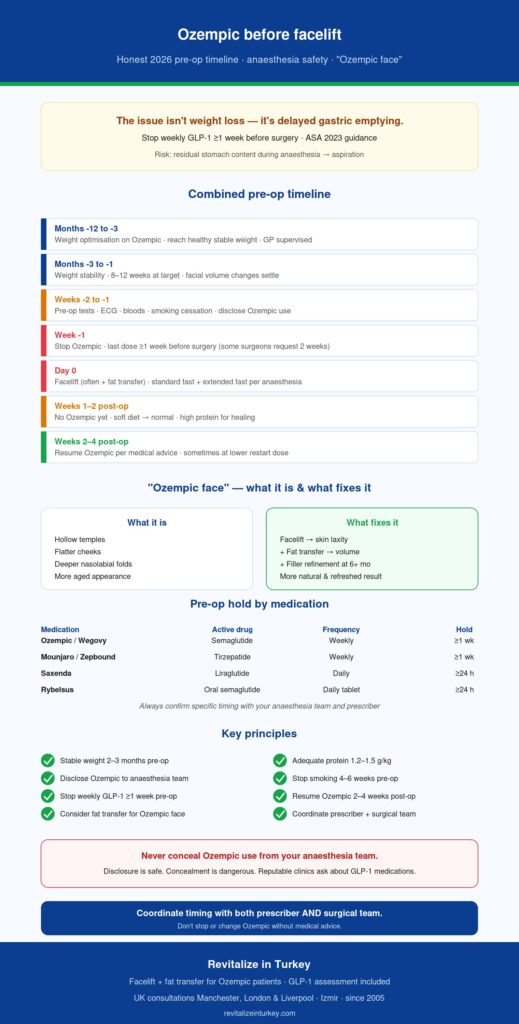
- Ozempic before facelift — timeline infographic
- Why weight stability matters before facelift
- Fat transfer with facelift — the volume question
- The combined pre-op timeline
- When to resume Ozempic after facelift
- Wegovy, Mounjaro, Saxenda — same principles?
- Risks of not stopping Ozempic
- If your clinic doesn’t ask about Ozempic
- Frequently asked questions
- What to do next
The short answer
For facelift surgery under general anaesthesia, Ozempic should be stopped at least 1 week (one missed weekly dose) before surgery per ASA 2023 guidance — many surgeons request 2 weeks, particularly at higher semaglutide doses. The clinical reason is anaesthesia safety: Ozempic significantly slows gastric emptying, raising the risk of residual stomach content during anaesthetic induction and possible aspiration into the lungs. Beyond the anaesthesia stop, weight should be stable for 2–3 months before facelift surgery — patients still losing weight at the time of surgery can develop new facial laxity after the lift settles. Many Ozempic patients also discuss fat transfer at the same time as facelift to restore lost facial volume. Ozempic can usually be resumed 2–4 weeks post-op once normal eating is established. Your surgeon and the doctor who prescribed your Ozempic must agree the timing.
What is Ozempic (semaglutide)?
Ozempic is the brand name (developed by Novo Nordisk) for semaglutide, a once-weekly injectable GLP-1 receptor agonist. It was first approved for type 2 diabetes, and the same molecule under the brand name Wegovy is approved for weight management. In many countries Ozempic itself is prescribed off-label or privately for weight loss. There is also an oral form of semaglutide called Rybelsus, taken daily.
Clinical effects: semaglutide reduces appetite, increases satiety, and significantly slows gastric emptying. Clinical trials at full weight-loss doses have shown average weight loss in the range of 10–15% of body weight over a year. It is one of the most widely prescribed weight-loss medications globally, and a significant portion of cosmetic surgery patients in 2026 are on it or have recently used it.
Related medications in the same family include tirzepatide (Mounjaro / Zepbound), liraglutide (Saxenda — daily injection), and others. The pre-op principles in this guide apply to all of them, with some differences in timing covered below. See our companion article on Mounjaro before tummy tuck for the tirzepatide-specific guidance, which uses the same framework.
The “Ozempic face” phenomenon
“Ozempic face” isn’t a clinical diagnosis — it’s a popular term for the facial appearance changes that can follow significant rapid weight loss on any GLP-1 medication. The face has several deep fat compartments (cheek, temple, peri-orbital, peri-oral). When body weight reduces substantially over months, these compartments deflate. The result: hollowed temples, flatter cheeks, deeper nasolabial folds, and a more aged appearance — sometimes called “deflated” by patients.
Several real factors contribute:
- Loss of facial fat volume — the primary driver.
- Skin laxity emerging as the underlying fat volume reduces, similar to but more rapid than ageing-related changes.
- Reduced collagen turnover in some patients during rapid weight loss.
Many patients arriving for facelift consultations in 2026 specifically cite Ozempic face as the prompt. The good news: facelift addresses the skin laxity component very effectively. The volume component is best addressed by combining facelift with fat transfer (or sometimes filler), which is increasingly common — discussed below.
The clinical issue: delayed gastric emptying
The reason to stop Ozempic before surgery isn’t the weight loss — it’s the gastric effect. Semaglutide significantly slows gastric emptying. Food and fluid can remain in the stomach much longer than normal after meals. During the induction of general anaesthesia, residual stomach content can be regurgitated and inhaled into the lungs — known as aspiration — which can cause aspiration pneumonia or, rarely, more serious airway complications. Standard pre-op fasting protocols were designed assuming normal gastric emptying. On Ozempic, that assumption no longer holds. The cessation period allows the stomach to return to normal emptying before surgery.
Several anaesthesia case reports between 2022 and 2024 documented residual gastric content in patients on GLP-1 medications who had followed standard fasting. These reports prompted updated guidance from anaesthesia societies. The risk is procedure-independent — it applies to any surgery under general anaesthesia or deep sedation, including facelift.
How long to stop Ozempic before facelift
Current consensus guidance:
- ASA 2023 guidance: Hold once-weekly GLP-1 medications (including Ozempic/semaglutide) for at least 1 week before procedures requiring general anaesthesia or deep sedation.
- Many practitioners (2024+ guidance) have moved toward longer hold times — sometimes up to 2 weeks for higher-dose semaglutide.
- Extended fasting protocols are also used by some teams: 12-hour fast for solids and 4-hour for clear fluids on the day of surgery, rather than the standard 6/2.
- Pre-op gastric ultrasound is increasingly used to confirm an empty stomach in some centres for higher-risk patients.
- Wegovy (the same molecule as Ozempic, marketed for obesity) is treated identically.
- Rybelsus (oral daily semaglutide) is typically held for at least 24 hours.
Your anaesthesiologist makes the final call. Do not stop or change your Ozempic dose without consulting both your prescribing doctor and the surgical team.
Why weight stability matters before facelift
Beyond anaesthesia safety, there’s a result-quality reason to be at a stable weight before facelift. Facelift addresses skin laxity that already exists — it tightens what is there. If your body is still actively losing weight at the time of surgery, several things can happen:
- New facial laxity emerges as ongoing weight loss continues to deflate facial fat compartments after the facelift has tightened the skin to its current contour.
- Volume continues to change in cheeks and temples, producing a “deflated post-facelift” look that wasn’t there at the time of surgery.
- Result longevity may be reduced — what should be a 10-year facelift may show recurrent laxity sooner if weight loss continues meaningfully after surgery.
The clinical ideal: reach your target weight, hold it for 2–3 months to confirm stability, and then have facelift surgery on a stable facial structure. Most surgeons require this stable period before booking.
Fat transfer with facelift — the volume question
For Ozempic patients whose main concern is facial volume loss as well as skin laxity, facelift alone may not be the full answer. The skin will be tightened — but the underlying volume deficit remains. Many surgeons therefore now combine facelift with one of:
- Autologous fat transfer (lipofilling). Fat is harvested from elsewhere on the body (abdomen, flanks, thighs) and reinjected into the temples, cheeks, peri-oral and peri-orbital regions to restore volume. Long-lasting, with about 50–70% of the transferred fat surviving long-term. Done at the same surgical episode.
- Dermal fillers. Hyaluronic acid fillers can restore volume, particularly in the cheeks and temples. Typically performed 6–8 weeks after facelift (not at the same time, because of swelling and unpredictability of placement).
- Combination approach — surgical fat transfer at facelift, plus filler refinement at 6+ months.
For Ozempic patients with significant volume loss, this combination approach often produces a more natural-looking, refreshed result than facelift alone. Discuss with your surgeon during consultation — they’ll assess which combination suits your specific volume deficit and skin laxity.
The combined pre-op timeline
Months -12 to -3: Weight optimisation
Active weight loss on Ozempic under prescriber supervision. Reach a healthy stable weight.
Months -3 to -1: Weight stability
Maintain target weight for at least 8–12 weeks. Ozempic may continue at maintenance dose during this period. Facial volume changes should have stabilised. Surgical team confirms readiness.
Weeks -2 to -1: Pre-op preparation
Standard pre-op work-up (bloods, ECG, anaesthesia review). Stop smoking if you haven’t already — facelift requires 4–6 weeks of cessation. Medical clearance finalised.
Week -1 (or earlier): Stop Ozempic
Last Ozempic dose at least 1 week before surgery (some surgeons request 2 weeks). Confirmed in writing with both your prescribing doctor and the surgical anaesthesia team.
Day 0: Surgery
Facelift (possibly combined with fat transfer). Follow standard pre-op fasting plus any extended fasting protocol the anaesthesia team requests. Disclose all medications honestly during pre-op check-in.
Weeks 1–2 post-op: No Ozempic yet
Soft diet, gradual normal eating, healing protein priority. Ozempic typically held while you’re transitioning back to normal eating.
Weeks 2–4 post-op: Resume Ozempic per medical advice
Once eating normally and healing is on track, Ozempic can usually be resumed at maintenance dose. Some patients restart at a lower dose to re-acclimatise.
For procedure-specific facelift recovery detail, see our facelift recovery day-by-day guide.
When to resume Ozempic after facelift
Resuming too early can cause nausea (uncomfortable with facial surgery and increases blood pressure during the bruising phase) and may reduce protein/calorie intake needed for wound healing. Resuming too late may allow some weight rebound. Typical guidance:
- Wait until you’re eating normally — usually around 2 weeks post-facelift.
- Wound healing is on track — typically confirmed at the 2-week follow-up.
- Bruising is settling — vomiting from medication-induced nausea risks worsening neck and facial bruising.
- Your prescriber agrees — they may suggest restarting at a lower dose to re-acclimatise.
Many facelift patients resume Ozempic between week 2 and week 4 post-op. Some patients who reached goal weight choose to discontinue Ozempic at this point (with prescriber guidance) and rely on lifestyle. Others continue at maintenance dose long-term.
Wegovy, Mounjaro, Saxenda — same principles?
Yes — all these are GLP-1 medications (Mounjaro is dual GIP/GLP-1) that slow gastric emptying. Pre-op timing:
| Medication | Active drug | Frequency | Typical pre-op hold |
|---|---|---|---|
| Ozempic | Semaglutide | Weekly injection | ≥1 week |
| Wegovy | Semaglutide | Weekly injection | ≥1 week |
| Mounjaro / Zepbound | Tirzepatide | Weekly injection | ≥1 week |
| Saxenda | Liraglutide | Daily injection | ≥24 hours |
| Rybelsus | Oral semaglutide | Daily tablet | ≥24 hours |
Always confirm with your anaesthesia team and prescriber — guidance is evolving and your specific case may differ. See our Mounjaro before tummy tuck article for the tirzepatide-specific equivalent of this guide.
Risks of not stopping Ozempic
Aspiration pneumonia. Residual gastric content during anaesthetic induction can be inhaled into the lungs, causing chemical pneumonitis or bacterial pneumonia. The reason for the cessation guidance.
Post-op nausea and vomiting. Vomiting after facelift is uncomfortable and risks worsening bruising (particularly under-eye and neck bruising) and increasing tension on the wound.
Concealing Ozempic use is dangerous. Patients sometimes don’t disclose GLP-1 use because they’re embarrassed or worried surgery will be delayed. Anaesthesiologists need to know — for your safety. Disclosure is the right answer, always. If you’ve taken Ozempic within the previous week, tell your anaesthesia team. They may delay surgery, modify the plan, or use ultrasound to assess stomach contents — all of which are safer than concealment.
If your clinic doesn’t ask about Ozempic
By 2026, asking about Ozempic and other GLP-1 medications should be standard pre-op practice at any reputable clinic. If a clinic hasn’t asked whether you’re on any weight-loss medication when booking your facelift, that’s a red flag — see our safe clinic verification guide. Disclose anyway, in writing, in your medical history. Insist that the anaesthesiologist sees this disclosure before surgery. A reputable clinic handles this routinely; one that brushes it aside is one to avoid.
Frequently asked questions
Can I have a facelift while on Ozempic?
Yes, with appropriate timing. Ozempic should be stopped at least 1 week before surgery (sometimes longer) for anaesthesia safety. Weight should be stable for 2–3 months before surgery for best results. Ozempic can usually be resumed 2–4 weeks post-op once normal eating is established.
How long before facelift should I stop Ozempic?
Current consensus is at least 1 week (one missed weekly dose) per ASA 2023 guidance. Some surgeons request 2 weeks, particularly at higher semaglutide doses. Always confirm with both your prescribing doctor and the surgical team before changing your dose.
Will I need fat transfer with my facelift after Ozempic?
Often yes, particularly if you have significant facial volume loss (“Ozempic face”). Facelift tightens skin but doesn’t restore lost volume. Combining facelift with autologous fat transfer (lipofilling) addresses both skin laxity and volume loss in one procedure — often producing a more natural, refreshed result than facelift alone. Discuss with your surgeon at consultation.
What is “Ozempic face”?
A popular term — not a clinical diagnosis — for facial appearance changes that often follow significant rapid weight loss on GLP-1 medications: hollow temples, flatter cheeks, deeper nasolabial folds and a more aged appearance. The cause is real (facial fat compartment volume loss). The good news: facelift addresses the skin laxity component, and fat transfer or filler addresses the volume component.
When can I restart Ozempic after facelift?
Typically 2–4 weeks post-op, once you’re eating normally and wound healing is on track. Your prescriber may suggest restarting at a lower dose to re-acclimatise. Resuming too early can cause nausea, which is particularly unwelcome after facial surgery — vomiting risks worsening bruising and wound tension.
Does Ozempic affect facelift results?
The weight loss itself doesn’t harm the result — but ongoing active weight loss at the time of surgery can. New facial laxity can emerge after the facelift if weight loss continues. Most surgeons want weight stable for 2–3 months before surgery for optimal long-term result.
Do I need to tell my surgeon I’m on Ozempic?
Yes, always — and the anaesthesia team specifically. Concealment is genuinely dangerous. Reputable clinics ask about all weight-loss medications as part of routine pre-op history. If they don’t ask, disclose anyway.
Is Wegovy or Mounjaro treated the same as Ozempic before surgery?
Yes — Wegovy is the same molecule as Ozempic (semaglutide), and Mounjaro (tirzepatide) is in the same drug family. All weekly GLP-1 medications should be held at least 1 week before surgery. Daily medications like Saxenda for at least 24 hours.
Can I keep losing weight after my facelift?
You can, but most surgeons recommend stable weight at the time of surgery for the best long-term result. After healing is complete (3+ months), moderate further weight loss is fine. Significant additional weight loss after facelift can produce additional facial laxity that may need a touch-up procedure.
What to do next
If you’re on Ozempic (or considering it) and planning a facelift, the most useful first step is a consultation that includes discussion of your weight stability, fat transfer options, and Ozempic cessation timing. Revitalize in Turkey routinely discusses GLP-1 medications during pre-op assessment, and our anaesthesia team is familiar with current ASA and UK guidance. Free consultations available in Manchester, London and Liverpool or remotely.
- Book a free consultation
- Deep plane facelift
- All facelift options
- Facelift recovery day by day
- Mounjaro before tummy tuck (companion article)
- Why BMI matters before surgery
Continue reading our medical tourism in Turkey cluster
- Complete Guide to Medical Tourism in Turkey
- What Is Medical Clearance?
- Understanding Surgical Risks
- How Smoking Affects Surgery Recovery
- How to Choose a Safe Clinic in Turkey
- 25 Questions to Ask Before Cosmetic Surgery
About the author
Revitalize In Turkey Medical Team, medical content writer specialising in pre-operative optimisation, GLP-1 medications and facial cosmetic surgery.
Medically reviewed by
Dr. Cenk Tokat Plastic Surgeon, Turkish Ministry of Health Registration No. [XXXX]. Member of the relevant Turkish specialist society.
Last reviewed: 26 May 2026.
This article is for general patient information and does not constitute medical advice. Ozempic and similar GLP-1 medications are prescription only; do not start, stop, or change the dose without supervision by the doctor who prescribed them. Anaesthesia guidance on GLP-1 medications evolves with new evidence — your anaesthesiologist gives definitive advice for your specific case. Always disclose all medications honestly during pre-op assessment.


 English
  Afrikaans
  Albanian
  Russian
  German
  Swedish
  Spanish
  Romanian
  Portuguese
  Japanese
  Azerbaijani
  Chinese
  Dutch
Dutch  French
  German (Formal)
  Greek
Greek