How Recovery Affects Final Results
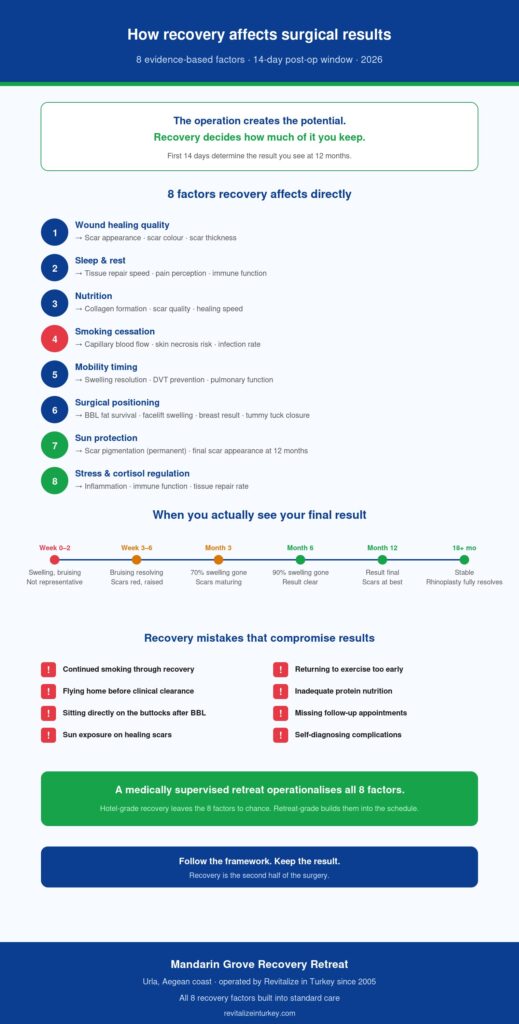
Recovery affects surgical results more than almost any other factor patients control. Two patients having the same operation by the same surgeon on the same day can end up with measurably different results 6 and 12 months later — and the variable explaining most of that difference is what each patient did, and what environment they were in, during the first 14 days post-op. This guide walks through the 8 evidence-based mechanisms by which recovery determines your aesthetic, functional and safety outcome: wound healing quality, sleep and rest, nutrition for tissue repair, smoking cessation, mobility timing, surgical positioning, sun protection, and stress regulation. Each one is supported by published surgical recovery research and the consensus framework of Enhanced Recovery After Surgery (ERAS). None of them are optional if the goal is the best possible long-term result.
The article is for patients who want to understand what recovery actually does to surgical results — and what choices in the first two weeks make the difference between a good outcome and an excellent one. Whether you’re planning surgery in the UK, US or as an international medical tourism patient in Turkey, the principles are identical.
Table of contents
- The short answer
- Why recovery matters more than patients realise
- Factor 1: Wound healing quality determines scar appearance
- Factor 2: Sleep and rest power tissue repair
- Factor 3: Nutrition fuels healing
- Recovery timeline infographic — what happens, when
- Factor 4: Smoking cessation preserves blood supply
- Factor 5: Mobility timing reduces swelling and DVT
- Factor 6: Surgical positioning preserves the result
- Factor 7: Sun protection determines scar maturation
- Factor 8: Stress and cortisol regulation
- Recovery factors by procedure
- The result-timeline: when you actually see your final outcome
- Common recovery mistakes that compromise results
- How retreat-based recovery improves outcomes
- Frequently asked questions
- What to do next
The short answer
The way recovery affects surgical results can be summarised in one sentence: the operation gives the surgeon’s best version of your result; the next 14 days decide how much of that potential you actually keep. Wound healing quality determines your scars. Sleep, nutrition and stress regulation determine how fast and how completely tissues repair. Smoking cessation preserves the blood supply to healing skin and flaps. Mobility timing prevents swelling, fluid retention and clots. Positioning preserves the shape the surgeon created. Sun protection determines how scars mature over the following year. Each factor is small in isolation; combined, they explain the difference between an excellent long-term result and a disappointing one — even when the same surgeon performed the same procedure.
Why recovery matters more than patients realise
The intuitive model of cosmetic surgery is “the operation is the result.” It isn’t. The operation is the starting point. What happens next determines what the final result looks like at 6 months and 12 months — when results matter most.
This is why surgeons emphasise post-op instructions so heavily; why medical literature on Enhanced Recovery After Surgery is one of the most-developed areas of modern surgical science; and why reputable medical tourism clinics increasingly use medically supervised recovery retreats. The first 14 days post-op is the window where outcome quality is largely written.
Two patients having identical rhinoplasty by the same surgeon on the same day, one of whom smokes through recovery and discharges to a city hotel, the other of whom doesn’t smoke and recovers in a medically supervised retreat, will likely have measurably different results at 12 months — both aesthetically (scar quality, skin healing, tip definition) and functionally (breathing). The operation didn’t change. What changed is what recovery did to the result.
Factor 1: Wound healing quality determines scar appearance
The mechanism
Every incision triggers a four-stage healing cascade: haemostasis (clotting), inflammation, proliferation (new tissue formation), and remodelling (scar maturation). Disruption at any stage degrades the final scar. The biggest disruptors: poor blood supply (smoking, hypertension, diabetes), excessive tension on the wound (movement, weight, swelling), infection, and inadequate nutrition.What this means for your result. Patients who optimise wound healing during the first 6 weeks usually end up with thin, pale scars at 12 months. Patients who don’t can develop hypertrophic scars (raised, red), keloid scars (extending beyond the wound), or simply visible, persistent scars. The patient choices that protect wound healing: no smoking, no nicotine; gentle mobility; protein-adequate nutrition; controlled blood pressure; sun protection during the first 12 months; scar massage from week 3 onward; silicone gel or sheets from week 2 onward. Reputable surgeons issue a wound-care protocol covering each of these.
Factor 2: Sleep and rest power tissue repair
The mechanism
Most tissue repair happens during deep sleep — particularly stage 3 (slow-wave sleep), when growth hormone release peaks and inflammatory cytokines reset. Sleep-deprived patients heal measurably more slowly across multiple surgical specialties. The post-operative environment matters: noisy hotels, frequent interruptions, uncomfortable positioning, and untreated pain all fragment sleep architecture.What this means for your result. Patients who sleep well in the first 7–10 days post-op heal faster, develop better scars, and report lower pain scores. A medically supervised recovery environment that prioritises sleep (quiet, low-light at night, ergonomic positioning, well-controlled pain) directly improves the result. This is one of the under-appreciated reasons why coastal recovery retreats outperform city hotels for major surgery.
Factor 3: Nutrition fuels healing
The mechanism
Wound healing is a protein-intensive process. The body requires elevated protein intake in the first 2–4 weeks post-op — typically around 1.2–1.5 g per kg body weight per day, versus 0.8 g baseline. Inadequate protein delays healing, weakens scars, and impairs immune function. Specific micronutrients also matter: vitamin C (collagen synthesis), vitamin D, zinc, iron. Hydration matters as well — dehydration thickens blood and slows tissue perfusion.What this means for your result. Patients eating dietitian-designed recovery meals (procedure-appropriate, protein-adequate, micronutrient-supportive) heal noticeably faster than patients living on hotel breakfast buffets. After bariatric surgery, nutritional protocols are even more procedure-specific — the difference between a structured high-protein post-op diet and an unstructured one shows up in long-term outcome.
Factor 4: Smoking cessation preserves blood supply
The mechanism
Nicotine constricts small blood vessels, reducing oxygen delivery to healing tissues by up to 30–40%. This is particularly consequential in procedures involving long incisions or skin flaps — facelift, tummy tuck, breast lift — where the skin’s blood supply is partially interrupted by the surgery itself. A smoker losing another 30–40% of capillary perfusion is at substantially elevated risk of skin necrosis, wound breakdown, infection and severely visible scarring.What this means for your result. The standard advice — stop all nicotine (cigarettes, vaping, replacement) at least 4 weeks pre-op and 4–6 weeks post-op — is not arbitrary. It’s the time period your blood vessels need to recover normal vasomotor function. Patients who comply have outcomes similar to non-smokers. Patients who don’t can be in the worst third of the bell curve regardless of how good the surgery was. This is the single biggest modifiable factor in recovery results.
Factor 5: Mobility timing reduces swelling and DVT
The mechanism
Early structured mobility — supervised walking, ankle pumps, deep breathing — reduces swelling by encouraging lymphatic drainage, prevents fluid accumulation in dependent areas, lowers the risk of deep vein thrombosis, and improves pulmonary function. NHS post-operative guidance reflects the same principle. The timing matters: too early disrupts the surgical repair; too late and risks accumulate. Reputable retreats follow a structured schedule.What this means for your result. Patients who follow the prescribed mobility schedule have less prolonged swelling, less skin laxity in body procedures (because fluid resolution is faster), and a more rapid emergence of the surgical contour. Excessive bed rest can actually worsen long-term results — the swelling persists longer, scars accumulate more inflammatory pigmentation, and DVT risk climbs.
Factor 6: Surgical positioning preserves the result
The mechanism
Many cosmetic procedures rely on the patient maintaining specific positioning during recovery to preserve the surgical shape. Examples:
- Facelift: head elevated for the first 7–10 days to minimise swelling and bleeding.
- BBL: no sitting directly on the buttocks for 2–3 weeks (specialised BBL pillow used); fat graft survival depends on undisturbed contact with native tissue.
- Tummy tuck: flexed-hip “beach chair” position for the first 7–14 days to reduce tension on the abdominal closure.
- Breast augmentation: avoid arms above shoulder for 2–3 weeks to prevent capsular displacement and bleeding.
- Hair transplant: avoid pressure on grafts in the first 7 days.
What this means for your result. Failure to follow positioning protocols is one of the leading causes of preventable complications: BBL fat graft loss, facelift swelling persistence, tummy tuck wound dehiscence, breast implant displacement. A medically supervised retreat enforces correct positioning in a way self-directed home recovery often doesn’t.
Factor 7: Sun protection determines scar maturation
The mechanism
UV exposure on new scars triggers melanin production that becomes permanent. Scars exposed to sun in the first 6–12 months can become hyperpigmented (dark brown) or stay red-pink for years rather than fading to skin-tone. This is one of the most under-appreciated factors in long-term aesthetic outcome.What this means for your result. SPF 50+ on all scars for at least 12 months, regardless of weather. Hats and clothing where possible. Avoid sunbeds entirely during scar maturation. Patients who protect their scars typically end up with fine, pale, almost invisible lines at 12 months. Patients who don’t can have pigmented, persistent scars they live with permanently. The Aegean coast climate (300+ sunny days a year) makes this particularly important — recovery retreats provide structured sun-management as part of standard care.
Factor 8: Stress and cortisol regulation
The mechanism
Chronic stress elevates cortisol, which suppresses inflammatory healing, slows tissue repair, and impairs immune function. Acute pre- and post-operative anxiety is normal and short-lived; chronic stress through recovery isn’t. Patients who feel isolated, anxious, or under-supported during recovery have measurably worse healing markers than patients in a calm, supportive environment.What this means for your result. A predictable routine, English-speaking clinical staff, surgeon contactable, and a calm physical environment translate into lower cortisol and better healing. This is particularly important for international patients far from home — the psychological support layer of a medically supervised retreat is not a luxury but a measurable contributor to outcome quality.
Recovery factors by procedure
| Procedure | Most outcome-critical recovery factors |
|---|---|
| Rhinoplasty | Head elevation · no glasses on bridge · sun protection on scars · sleep position · no nose-blowing for 2 weeks |
| Deep plane facelift | Head elevation · no smoking · structured mobility · sun protection · meticulous wound care |
| Breast augmentation | No arms-above-shoulder · positioning compliance · scar care · gradual return to exercise |
| Tummy tuck | Flexed-hip position · no smoking · compression garment · scar care · gentle mobility |
| BBL | No direct sitting (BBL pillow) · positioning compliance · adequate nutrition for fat-graft survival |
| Liposaksiya | Compression garment · structured walking · lymphatic massage from week 3 |
| Hair transplant | No pressure on grafts · sleep position · gentle washing schedule · sun protection |
| LASIK | No rubbing eyes · sunglasses · prescribed eye drops · screen breaks |
| Dental implants | Soft diet · no smoking · oral hygiene · avoid disturbance to surgical site |
| Gastric sleeve | Strict dietary stages · adequate protein · supplements · gradual reintroduction · long-term lifestyle compliance |
The result-timeline: when you actually see your final outcome
One of the most under-communicated parts of cosmetic surgery: the “final result” is not visible at week 1, or week 4, or sometimes even at month 3. Different procedures resolve over different timeframes:
- Week 0–2. Heavy swelling, bruising. Not representative of result.
- Week 3–6. Bruising mostly resolved. Significant swelling still present. Scars red and raised.
- Month 3. ~70% of swelling resolved for most procedures. Scars beginning to mature.
- Month 6. ~90% of swelling resolved. Scars settling into final colour/texture. Aesthetic result becoming clear.
- Month 12. Result essentially final. Scars at their best.
- Month 18+. Scars may continue to mature subtly. Result stable.
Patients who panic at week 3 because “my nose still looks swollen” are typically panicking too early. Patients who don’t see their result at month 12 are seeing the result that recovery produced. The take-home: the first 14 days of recovery shape the result you see at 12 months. Both the operation and the recovery contribute to the outcome.
Common recovery mistakes that compromise results
Returning to exercise too early. Increases bleeding risk, swelling, and risks wound dehiscence in body procedures. Follow the surgeon’s specific clearance timeline.
Continuing to smoke through recovery. Most damaging single factor. Compounds every other risk in this list.
Flying home too soon. DVT and PE risk. Disturbs swelling. Removes access to clinical support if a complication develops.
Ignoring positioning instructions. Compromises the surgical shape. BBL is the most documented example — sitting on the buttocks in the first 2 weeks materially reduces fat graft survival.
Sun exposure on scars. Permanently darkens scars. Cannot be reversed once it occurs.
Missing follow-up appointments. Misses the early intervention window for any developing issue.
Self-diagnosing complications. Patients who Google symptoms rather than contacting their clinic delay treatment of things that needed immediate attention.
Drinking alcohol too early. Slows healing, thins blood, interacts with pain medication.
Stopping prescribed medications early. Particularly antibiotics — finishing the course matters.
How retreat-based recovery improves outcomes
A medically supervised recovery retreat systematically improves results because it operationalises every one of the 8 factors above:
- Wound healing is supported by scheduled sterile dressings.
- Sleep is protected by a purpose-designed quiet environment.
- Nutrition is provided by dietitian-designed meals.
- Smoking cessation is enforced by the no-smoking environment.
- Mobility is structured and supervised.
- Positioning is enforced by trained staff.
- Sun exposure is managed within structured outdoor time.
- Stress is reduced by predictable routine and on-site clinical support.
The Mandarin Grove Recovery Retreat, operated by Revitalize in Turkey since 2005, applies this framework as standard. Outcomes for international patients in this kind of supervised environment are measurably closer to UK and US private practice outcomes than outcomes for patients discharged to hotels.
Frequently asked questions
How long until I see my final cosmetic surgery result?
Procedure-dependent. Most cosmetic surgery results are 90% visible at 6 months and final at 12 months. Some procedures (rhinoplasty in particular) take 12–18 months for swelling to fully resolve. Bariatric weight-loss surgery results continue evolving for 12–18 months.
Why does recovery affect surgical results so much?
Because the operation creates the potential result; recovery determines how much of that potential is preserved. Wound healing decides your scars, blood supply decides skin survival, nutrition decides tissue repair quality, positioning decides whether the surgical shape is preserved, and sun protection decides scar colour for the next 12 months.
Can a bad recovery ruin a good surgical result?
It can substantially degrade it. The most documented example is BBL — patients sitting on their buttocks in the first 2–3 weeks lose fat graft survival, reducing the volume retained. Patients who smoke through facelift recovery can develop skin necrosis even with an excellent operation. Recovery doesn’t usually “ruin” a result, but it can convert what should have been an excellent result into a mediocre one.
What’s the most important thing I can do during recovery?
Stop smoking and follow the surgeon’s specific instructions. Those two factors combined account for most of the patient-controlled variation in outcomes.
Why is the first 14 days post-op so critical?
Almost all time-sensitive healing milestones — initial wound healing, peak inflammation resolution, scar formation initiation, DVT risk window, infection emergence — happen in this period. Decisions made or missed in this window shape the trajectory of recovery for the following 12 months.
Can I recover at home after Turkey surgery instead of a retreat?
For day-case procedures (LASIK, hair transplant, simple dental), home recovery is appropriate once the immediate post-op period is completed. For major surgery, a structured retreat-based recovery measurably improves results compared to home recovery — particularly for international patients without home medical support.
How important is nutrition during recovery?
Very. Wound healing is protein-intensive (typically 1.2–1.5 g per kg body weight per day in the first 2–4 weeks). Vitamin C, vitamin D, zinc and iron also matter. Hydration matters. Dietitian-designed recovery meals improve healing speed and scar quality measurably.
When can I exercise after surgery?
Procedure-specific. Light walking is encouraged from day 1; structured exercise is usually 4–6 weeks for body procedures, 6–8 weeks for major surgery. Heavy lifting and impact exercise typically wait until 8–12 weeks. Returning early can cause bleeding, swelling and wound dehiscence — and compromise the result.
How does smoking affect cosmetic surgery results?
It dramatically impairs wound healing by reducing capillary blood supply 30–40%. Patients who smoke through recovery have substantially higher rates of skin necrosis, wound infection, hypertrophic scarring and overall poorer aesthetic outcomes. Standard advice is no nicotine for 4–6 weeks pre-op and 4–6 weeks post-op.
What to do next
If you’re planning surgery in Turkey, the recovery framework matters as much as the surgery itself. Revitalize in Turkey builds the 8 recovery factors above into the standard package — surgery in an accredited hospital, transfer to medically supervised recovery, dietitian-designed meals, structured mobility, sun-managed outdoor time, no smoking enforced, English-speaking clinical staff, and a discharge gated by clinical readiness rather than your booked flight.
- Tour the Mandarin Grove Recovery Retreat
- Book a free UK consultation
- See our end-to-end treatment process
- Aftercare overview
- Why Revitalize in Turkey
- Read independent patient reviews
Continue reading our medical tourism in Turkey cluster
- How Recovery Retreats Improve Surgical Outcomes
- Understanding Surgical Risks: 7 Essential Categories
- How Surgeons Assess Surgical Candidates
- 25 Questions to Ask Before Cosmetic Surgery
- How to Choose a Safe Clinic in Turkey
- What to Expect When Travelling to Turkey for Surgery
- Complete Guide to Medical Tourism in Turkey
About the author
RevitalizeInTurkey Medical Team, medical content writer specialising in surgical recovery science and post-operative outcomes.
Medically reviewed by
Dr. Melih Can, Plastic and Reconstructive Surgeon, Turkish Ministry of Health Registration No. [XXXX]. Member of the Turkish Society of Plastic, Reconstructive and Aesthetic Surgeons (TSPRAS).
Last reviewed: 26 May 2026.
This article is for general patient information and does not constitute medical advice. Recovery is procedure- and patient-specific. Always follow the recovery plan issued by your operating surgeon and consult a licensed medical professional for any post-operative concern.

 English
  Afrikaans
  Albanian
  Russian
  German
  Swedish
  Spanish
  Romanian
  Portuguese
  Japanese
  Azerbaijani
  Chinese
  Dutch
Dutch  French
  German (Formal)
  Greek
Greek