
BMI before surgery is one of the most consequential clinical variables in any elective operation. Reputable surgeons across the UK, US, EU and Turkey use BMI as a primary filter during patient assessment — not because it’s a moral judgement, but because BMI correlates strongly with operative risk, recovery quality and final aesthetic outcome. This guide explains the 7 clinical reasons BMI matters before surgery, the safe BMI ranges for major cosmetic, dental, hair, eye and bariatric procedures in 2026, what “optimise your BMI” actually means in practice, and how to safely reach a target BMI before booking. The framework here is the same one used by BAAPS in the UK, NICE in clinical commissioning guidance, and TSPRAS in Turkish private practice.
BMI is not a perfect measure — it doesn’t distinguish muscle from fat, and edge cases exist (athletic builds, sarcopenic elderly patients). But for the great majority of elective surgical patients, BMI predicts complication risk and outcome quality measurably. Understanding why your surgeon cares about it — and what to do about it — is part of being a prepared patient.
Table of contents
- The short answer
- What BMI is — and what it isn’t
- Reason 1: Anaesthesia risk scales with BMI
- Reason 2: Bleeding and intraoperative complications
- Reason 3: Wound healing impairment
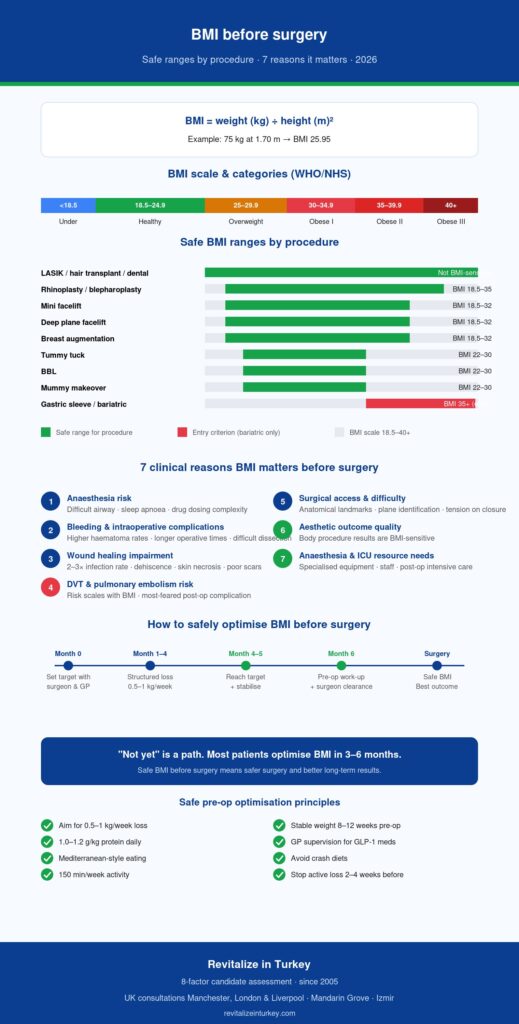
- BMI before surgery — safe-range infographic
- Reason 4: DVT and pulmonary embolism risk
- Reason 5: Surgical access and technical difficulty
- Reason 6: Aesthetic outcome quality is BMI-sensitive
- Reason 7: Anaesthesia and ICU resource implications
- Safe BMI ranges by procedure
- What “optimise your BMI” actually means
- Too-low BMI matters too
- How to safely lose weight before surgery
- BMI limitations and edge cases
- Frequently asked questions
- What to do next
The short answer
BMI before surgery affects 7 distinct clinical variables: anaesthesia risk, bleeding, wound healing, DVT/PE risk, surgical access, aesthetic outcome, and resource needs. For most cosmetic body procedures the safe range is BMI 22–32; tummy tuck and BBL prefer BMI 22–30; gastric sleeve and bariatric procedures have a minimum BMI 35 (with comorbidity) or 40. Hair transplant, LASIK, and most dental procedures are not significantly BMI-sensitive. If your BMI is above the safe range, your surgeon will typically request optimisation — not because the surgery is impossible, but because complication risk and outcome quality both improve with weight loss. Optimising is a path; “no” is rare. Most patients can reach a safe range with 3–6 months of structured weight loss.
What BMI is — and what it isn’t
Body Mass Index (BMI) is calculated as weight in kilograms divided by height in metres squared (kg/m²). The WHO and NHS standard categories are:
BMI formula: weight (kg) ÷ height (m)² = BMI
- Under 18.5: underweight
- 18.5–24.9: healthy weight
- 25–29.9: overweight
- 30–34.9: obese class I
- 35–39.9: obese class II
- 40+: obese class III (morbid)
Example: a 75 kg patient at 1.70 m height has BMI 25.95 (25.95 = 75 ÷ 1.70² = 75 ÷ 2.89).
BMI is a useful approximation for the population average but has known limitations. It overestimates body fat in muscular builds (athletes, weight-trained individuals) and underestimates it in sedentary older adults with reduced muscle mass. For surgical risk assessment, BMI is used as the starting point — but reputable surgeons consider it alongside body composition, fat distribution (visceral vs subcutaneous), and overall health metrics.
Reason 1: Anaesthesia risk scales with BMI
The mechanism
General anaesthesia involves managing breathing, circulation, body temperature and consciousness simultaneously. As BMI increases, each of these becomes harder to manage:
- Airway management. Higher BMI is associated with more difficult intubation, higher rates of sleep apnoea (often undiagnosed), and reduced oxygen reserves.
- Cardiovascular load. Higher BMI patients more often have hypertension, undiagnosed cardiac disease, and reduced exercise tolerance — all of which raise anaesthetic risk.
- Drug dosing. Anaesthetic drug clearance changes with body composition; dosing in high-BMI patients is more technically demanding.
- Recovery from anaesthesia. High-BMI patients have higher rates of post-operative nausea and vomiting, longer recovery times, and higher rates of respiratory complications immediately post-op.
Reputable anaesthesia teams are well-equipped to manage high-BMI patients in accredited hospital settings, but the risk profile is genuinely higher than for a BMI 22–28 patient, all else equal.
Reason 2: Bleeding and intraoperative complications
The mechanism
Higher BMI is associated with several specific intraoperative complications:
- Increased intra-operative bleeding in many body procedures — fatty tissue has rich vascular supply.
- Difficult dissection planes. Excessive subcutaneous fat makes anatomical landmarks harder to identify and key structures harder to protect.
- Longer operative time. Each minute of additional operating time compounds anaesthesia exposure and infection risk.
- Higher post-operative haematoma rates. Particularly in facelift and abdominal procedures.
Reason 3: Wound healing impairment
The mechanism
Wound healing is the single most documented BMI-sensitive outcome. High-BMI patients have measurably higher rates of:
- Surgical site infection (often 2–3× the baseline rate).
- Wound dehiscence (the wound opening after closure).
- Skin necrosis at incision edges, particularly in long incision procedures like tummy tuck.
- Hypertrophic and persistent scarring.
- Slower overall healing.
The mechanism combines reduced tissue perfusion (fatty tissue has poorer blood supply per gram), higher tension on closures (more tissue to close), and altered immune function in obesity.
Reason 4: DVT and pulmonary embolism risk
The mechanism
Venous thromboembolism — DVT and pulmonary embolism — is one of the most-feared post-operative complications globally. Risk scales with BMI in a well-documented pattern. Higher-BMI patients have reduced venous return from the legs, higher resting inflammatory markers, and longer immobilisation in the early post-op period — each contributing to clot risk. Standard prophylactic measures (compression, early mobilisation, anticoagulant injections) work in all patients but are calibrated more aggressively in higher-BMI surgery.
Reason 5: Surgical access and technical difficulty
The mechanism
Certain procedures are technically more difficult at higher BMI:
- Tummy tuck: excess subcutaneous fat increases tissue volume to be removed and the tension on closure.
- Breast reduction or augmentation: tissue thickness affects symmetry and result.
- BBL: while adequate donor fat is required, very high BMI complicates contour outcomes.
- Facelift: fatty cheeks and neck affect the surgical plane and result.
- Abdominal access for gallbladder, hernia, gynaecological surgery: can be substantially more difficult.
“Difficulty” is not necessarily a contraindication — but it does mean a higher-BMI surgery requires more experienced surgeons and longer operative time, both of which influence the risk profile.
Reason 6: Aesthetic outcome quality is BMI-sensitive
The mechanism
For body cosmetic procedures, the achievable aesthetic result depends heavily on starting BMI. A patient at BMI 28 undergoing tummy tuck typically has a more defined waist and flatter abdomen at 6 months than a patient at BMI 34 undergoing the same procedure with the same surgeon. The same applies to BBL contour, breast reduction shape, and facelift jawline definition. The procedure can only do so much — the underlying body composition limits the result.
This is why surgeons sometimes ask patients to lose weight not because surgery is unsafe at their current BMI, but because the result will be measurably better at a lower BMI. Patients who optimise BMI before surgery routinely report higher satisfaction at 6 and 12 months.
Reason 7: Anaesthesia and ICU resource implications
The mechanism
Higher-BMI surgery requires specific resources — larger operating tables, specialised positioning equipment, additional theatre staff, and a higher likelihood of post-operative ICU care. Reputable hospitals plan for this routinely; but accredited Grade A hospitals are the appropriate setting for high-BMI surgery, not clinic-based theatres. This is why many international medical tourism clinics will turn away high-BMI patients for major surgery unless they can ensure full hospital-grade care.
Safe BMI ranges by procedure
| Prosedure | Typical safe BMI | Optimisation requested above | Notes |
|---|---|---|---|
| LASIK / SMILE laser eye | Not BMI-sensitive | n/a | Eye procedures rarely BMI-limited |
| Dental implants | Not BMI-sensitive | n/a | Procedure performed under sedation/local; bone-driven |
| Hair transplant | Not BMI-sensitive | n/a | Local anaesthesia, hair-density driven |
| Blepharoplasty | 18.5–35 | Rarely BMI-limited | Day case; local plus sedation often acceptable |
| Rhinoplasty | 18.5–35 | Rarely BMI-limited | Less BMI-sensitive than body procedures |
| Mini facelift | 18.5–32 | BMI 32+ | Skin elasticity also matters |
| Deep plane facelift | 18.5–32 | BMI 32+ | Higher BMI compromises jawline definition |
| Breast augmentation | 18.5–32 | BMI 32+ | Stable weight more important than absolute BMI |
| Breast reduction | 18.5–32 | BMI 32+ | NHS criteria stricter still |
| Tummy tuck (abdominoplasty) | 22–30 | BMI 30+ | Risk-benefit shifts above BMI 30 |
| BBL (Brazilian Butt Lift) | 22–30 | BMI 30+ (also too-low limit) | Need adequate donor fat AND safe BMI |
| Liposuction (single area) | 18.5–32 | BMI 32+ | Not a weight-loss procedure |
| Mummy makeover | 22–30 | BMI 30+ | Combination procedure compounds risk |
| Gastric sleeve / bypass | Min BMI 35+ with comorbidity, or 40+ | Below 35: not a candidate | Bariatric criteria are BMI-driven |
Ranges are typical clinical guidance. Individual decisions depend on full health assessment, body composition, and surgeon judgement. Always discuss your specific case in consultation.
What “optimise your BMI” actually means
When a surgeon says “we should optimise your BMI before surgery,” they typically mean one or more of the following:
- Reach a specific target BMI. For tummy tuck, BBL or major body work, often a target around BMI 28 or lower.
- Demonstrate stable weight for 3+ months. Stability is usually as important as the absolute number — yo-yo weight predicts poor body procedure outcomes.
- Optimise body composition. For some patients (athletic builds), the absolute BMI is high but body composition is acceptable; the surgeon may use waist circumference or body fat measurements as the actual criterion.
- Treat related conditions. Sleep apnoea, hypertension or diabetes often improves with weight loss, and benefits surgical safety.
- Lose specific intra-abdominal fat (sometimes harder than subcutaneous fat) for procedures involving abdominal access.
Too-low BMI matters too
BMI below the safe range is also problematic. Patients with BMI below 18.5 may face:
- Inadequate donor fat for fat-grafting procedures like BBL or facial fat transfer.
- Poor nutritional reserves for wound healing.
- Less subcutaneous tissue cushioning for implants in breast augmentation.
- Suspicion of undiagnosed eating disorder — many surgeons screen for this before approving body or facial surgery.
- Worse aesthetic outcomes in body contouring (very thin skin shows surgical lines more visibly).
Optimisation in this direction means addressing the underlying cause — nutritional intake, eating disorder treatment, or general health stabilisation — before booking elective surgery.
How to safely lose weight before surgery
If your surgeon requests pre-op weight loss, the safest approach combines:
- A realistic target. Typically 3–6 months to lose 5–15 kg for most patients. Aim for 0.5–1 kg/week.
- GP involvement. Your UK NHS GP can support weight loss planning, screen for thyroid or metabolic issues, and prescribe weight-management medication where appropriate.
- Structured dietary support. Mediterranean-style eating, adequate protein (1.0–1.2 g/kg body weight), modest calorie deficit (300–500 kcal/day).
- Regular activity. 150 minutes/week of moderate activity is the baseline. Doesn’t need to be the gym — walking counts.
- Weight stability before surgery. Reach the target, then maintain for 8–12 weeks before booking — this avoids the body still being in active weight loss at surgery, which complicates tissue planes and healing.
- GLP-1 agonist medication if appropriate. Semaglutide and tirzepatide are commonly used; require GP prescription and supervision. Most surgeons prefer the medication stopped 1–2 weeks before surgery; confirm specific guidance with your team.
- Stop the weight-loss process several weeks before surgery. Active calorie restriction during the wound healing window impairs recovery.
Very rapid weight loss (crash diets, very-low-calorie regimens, fasting) is not recommended pre-surgery — it depletes nutritional reserves needed for wound healing. Sustainable, structured loss is the right pattern.
BMI limitations and edge cases
BMI works for the average patient but misclassifies several groups:
- Muscular builds. Athletes and weight-trained individuals can have BMI 28–32 with body fat percentages that wouldn’t concern any surgeon. Body composition measurement clarifies the picture.
- Older sedentary adults. May have BMI 24 (apparently healthy) but high body fat percentage and low muscle mass — actually higher surgical risk than the number suggests.
- Patients of South Asian descent. WHO guidance recognises that South Asian populations carry metabolic risk at lower BMI than European populations. Some surgeons use lower BMI cutoffs accordingly.
- Post-bariatric patients with significant loose skin. May have BMI in the safe range but excess skin from previous weight loss — the procedure (body lift, tummy tuck, breast lift) is specifically designed for them.
- Recently pregnant patients. Body composition is still changing — typically wait 6–12 months post-pregnancy and 3–6 months post-breastfeeding before booking abdominal or breast procedures.
Frequently asked questions
Why does BMI matter for surgery?
BMI affects 7 distinct clinical variables: anaesthesia risk, intraoperative bleeding, wound healing, DVT and pulmonary embolism risk, surgical access and technique, aesthetic outcome quality, and resource needs. Higher BMI raises risk and reduces outcome quality in each. The relationship is strongest for body procedures (tummy tuck, BBL, mummy makeover) and weaker for non-body procedures (LASIK, hair transplant, dental).
What BMI is too high for cosmetic surgery?
Procedure-dependent. Most body procedures expect BMI under 32; tummy tuck and BBL prefer under 30. BMI above 35 is usually a “not yet” for most cosmetic body procedures. BMI above 40 is essentially a “no” for elective cosmetic surgery — bariatric surgery may be the appropriate first step.
What’s the minimum BMI for gastric sleeve in Turkey?
Standard criteria: BMI 35 with one or more obesity-related conditions (diabetes, hypertension, sleep apnoea), or BMI 40 without. Some patients with BMI 30–35 may be candidates for less invasive bariatric procedures (gastric balloon) rather than gastric sleeve.
Can I lose weight just before surgery?
Yes, but the safest approach is to reach your target weight 8–12 weeks before surgery and maintain it. Active rapid weight loss in the weeks immediately before surgery depletes nutritional reserves needed for healing. Crash diets are not recommended pre-op.
What if my BMI is too low for surgery?
BMI below 18.5 is also problematic. Issues include inadequate fat for fat-grafting procedures, poor nutritional reserves for healing, and screening flags for possible eating disorder. Optimisation here means working with your GP to gain weight healthily before booking.
Does muscle count differently from fat in BMI?
BMI doesn’t distinguish, which is a known limitation. For muscular or athletic patients, body composition measurement (waist circumference, body fat percentage) gives a more accurate clinical picture. Reputable surgeons use BMI as the starting point and refine with additional measurements where indicated.
How much weight should I lose before surgery?
Depends on starting point and procedure. Typical targets: bring BMI below 30 for tummy tuck/BBL, below 32 for most other body procedures, below 28 for the most demanding (deep plane facelift, mummy makeover). Most patients can reach these targets in 3–6 months with structured weight loss.
Are GLP-1 weight-loss medications safe before surgery?
They can be used as part of structured pre-op weight loss under GP supervision. Most surgeons request the medication be stopped 1–2 weeks before surgery to avoid intraoperative complications related to delayed gastric emptying. Confirm specific guidance with your surgeon and anaesthesiologist — don’t stop or change dose without medical advice.
Why is BMI required for bariatric surgery but not for hair transplant?
Because the risk and outcome profile of bariatric surgery is BMI-driven (BMI is essentially the entry criterion), while hair transplant is performed under local anaesthesia on the scalp and is not significantly affected by body weight. The clinical relevance of BMI varies dramatically by procedure.
What to do next
If you’re considering surgery and unsure whether your BMI is suitable, the most useful next step is a free consultation in which a coordinator and surgeon review your full medical picture — height, weight, body composition where relevant, health conditions, and chosen procedure. Revitalize in Turkey runs candidate assessment as part of every consultation; if optimisation is needed, we explain what’s required and when to rebook. We hold in-person UK consultations in Manchester, London and Liverpool, plus remote consultations worldwide.
- Book a free UK consultation
- How surgeons assess surgical candidates
- See our end-to-end treatment process
- Why Revitalize in Turkey
- Tour the Mandarin Grove Recovery Retreat
- Read independent patient reviews
Continue reading our medical tourism in Turkey cluster
- How Surgeons Assess Surgical Candidates (8-factor framework)
- Understanding Surgical Risks: 7 Essential Categories
- How Recovery Affects Final Results
- 25 Questions to Ask Before Cosmetic Surgery
- How to Choose a Safe Clinic in Turkey
- Complete Guide to Medical Tourism in Turkey
About the author
RevitalizeInTurkey Medical Team, medical content writer specialising in surgical candidate assessment and pre-operative optimisation.
Medically reviewed by
Dr. Ahmet Seyhan, Plastic and Reconstructive Surgeon, Turkish Ministry of Health Registration No. [XXXX]. Member of the Turkish Society of Plastic, Reconstructive and Aesthetic Surgeons (TSPRAS).
Last reviewed: 26 May 2026.
This article is for general patient information and does not constitute medical advice. BMI is one of several variables surgeons use; individual decisions depend on full medical assessment. Always consult a licensed medical professional before any weight-loss programme or surgical decision. GLP-1 weight-loss medications require GP prescription and supervision.

 English
  Afrikaans
  Albanian
  Russian
  German
  Swedish
  Spanish
  Romanian
  Portuguese
  Japanese
  Azerbaijani
  Chinese
  Dutch
Dutch  French
  German (Formal)
  Greek
Greek