Dental Implant Recovery Timeline
Dental implant recovery happens in two distinct phases over several months: an acute soft-tissue healing phase in the first 1–2 weeks, and a longer osseointegration phase of 3–6 months while the implant fuses with the jaw bone. The crown — the visible tooth — is placed only once osseointegration is complete (with some exceptions for immediate-load systems). This guide explains the dental implant recovery timeline day by day for the acute phase, then stage by stage through to final crown placement. It covers single implants, full-mouth implants and All-on-4, and explains why smoking has a uniquely large impact on dental implant success.
Dental implant surgery is one of the most predictable and successful procedures in modern dentistry — long-term success rates are commonly cited above 95% in healthy, non-smoking patients. The biggest variables determining your outcome are the surgeon’s planning, your oral hygiene during recovery, and whether you smoke. This guide is honest about both the comfort of the recovery (mostly easier than patients expect) and the time it takes (longer than most realise). Information is consistent with NHS, British Dental Association and international implantology guidance.
Table of contents
- The short answer
- The two phases of recovery
- Day 0 — surgery day
- Day 1
- Days 2–3
- Days 4–7
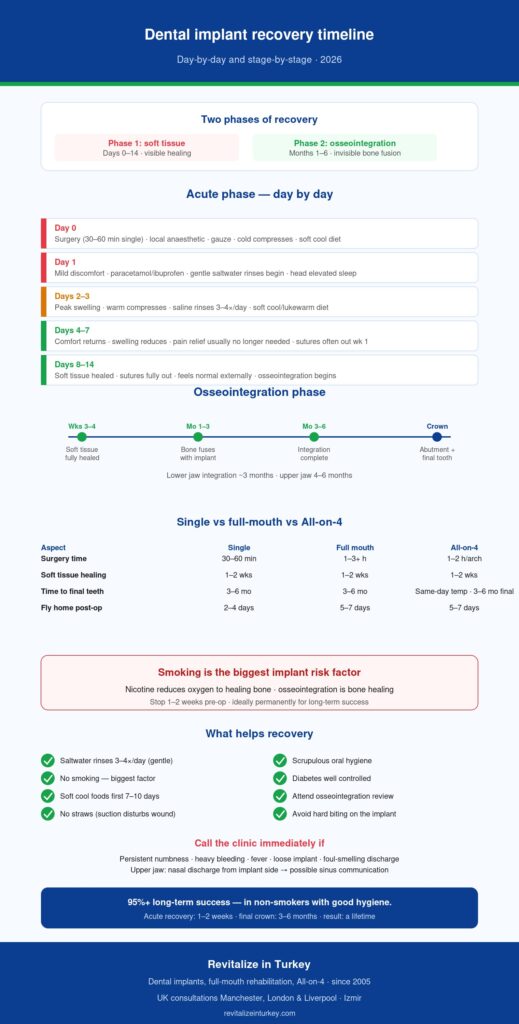
- Dental implant recovery timeline — infographic
- Days 8–14
- Weeks 3–4 — soft tissue healed
- Months 1–3 — osseointegration begins
- Months 3–6 — osseointegration complete
- Crown placement — the final tooth
- Single vs full-mouth vs All-on-4 recovery
- Smoking and dental implant success
- What helps recovery
- Red flags — when to call the clinic
- Frequently asked questions
- What to do next
The short answer
Dental implant recovery has two phases. The acute phase — soft tissue healing — runs about 1–2 weeks: most discomfort settles in 3–5 days, sutures come out at 1–2 weeks, and you eat soft foods throughout. The longer phase — osseointegration, where the titanium implant fuses with your jawbone — takes 3–6 months. The final crown is placed once osseointegration is confirmed. Total time from implant placement to functional tooth is typically 3–6 months for standard two-stage implants, or same-day for All-on-4 and immediate-load systems where a temporary fixed bridge is placed at surgery. Most patients are back to normal daily life within 1–3 days. Smoking dramatically reduces implant success and must stop pre- and post-op.
The two phases of recovery
Understanding dental implant recovery requires understanding that the visible healing (gums) and the invisible healing (bone) happen on different timelines:
- Phase 1 — Soft tissue healing (acute). Days 0–14. The gum and surface tissues heal. This is the phase where you feel anything — swelling, mild discomfort, soft-diet restrictions. By 2 weeks, the gum looks essentially normal.
- Phase 2 — Osseointegration (slow). Months 1–6. The titanium implant fuses biologically with the jaw bone. You feel nothing during this phase. The implant cannot bear normal chewing forces until osseointegration is well established.
The crown (the visible tooth, made of porcelain or zirconium) is added on top of the implant only once osseointegration is sufficient. For most standard two-stage protocols, that’s around month 3–6. Same-day options exist for selected cases.
Day 0 — surgery day
What’s happening
Implant placement under local anaesthetic (often with optional IV sedation for nervous patients or longer cases). The surgeon makes a small gum incision, prepares the bone, places the titanium implant, and closes the gum over (or around) it. Procedure time: ~30–60 minutes for a single implant; longer for multiple.What you’ll feel: Numbness during the procedure. As anaesthetic wears off over 2–4 hours, mild discomfort that responds well to paracetamol or ibuprofen. Gauze in place to control minor bleeding. What you’ll see: Small sutures, swelling beginning. What you’ll do: Bite gently on gauze for 30–60 minutes. Apply cold compresses outside the cheek (20 min on/off). Soft cold foods (yoghurt, smoothies, lukewarm soup). No rinsing for 24 hours. No smoking, no alcohol. Sleep with head slightly elevated.
Day 1
What’s happening
First full day post-op. Swelling typically increases through the day. Mild bruising may appear on the cheek or under the jaw. Continued use of prescribed analgesia and any prescribed antibiotic.What you’ll feel: Mild discomfort, well-controlled with paracetamol/ibuprofen. Swelling makes the cheek feel full. Eating still soft and cool. What you’ll see: Visible swelling, possibly slight bruising. What you’ll do: Continue cold compresses for the first 24 hours, then switch to warm compresses from day 2. Gentle saltwater rinses can begin (warm saline, no swishing — just gentle pooling). Soft, cool foods. Maintain hydration. No smoking, no alcohol, no straws.
Days 2–3
What’s happening
Swelling typically peaks on day 2 or 3 and then begins to reduce. Bruising (if present) may darken before fading. This is when most patients describe themselves as feeling “a bit rough” but not in significant pain.What you’ll feel: Peak swelling. Discomfort mild — pain relief usually needed only intermittently. Soft food still essential. What you’ll see: Cheek/jaw most swollen. Bruising may be visible. Sutures intact. What you’ll do: Warm compresses now (cold no longer helps after day 1). Gentle saltwater rinses 3–4 times daily, especially after meals. Continue soft cool/lukewarm diet. Avoid the surgical site when brushing — use a soft brush on adjacent teeth.
Days 4–7
What’s happening
Swelling reducing day by day. Bruising fading. Most patients describe themselves as essentially comfortable by day 5–7 — just careful around the surgical site. Sutures (if non-dissolvable) often come out at the end of week 1.What you’ll feel: Substantially better. Mild tenderness at the site only on direct pressure. Most patients off pain relief by day 5. What you’ll see: Swelling mostly gone by day 7. Bruising fading to yellow/green. Gum healing visibly. What you’ll do: Gradual return to slightly more textured foods (avoid hard, crunchy, sticky). Saltwater rinses continue. Normal brushing of all other teeth; soft brushing near the surgical site after day 5. International patients usually fit-to-fly from day 3–5 for single implants.
Days 8–14
What’s happening
Soft tissue healing essentially complete by day 10–14. Sutures fully removed by day 14. The visible recovery is now over — but the invisible osseointegration phase is just beginning underneath. Many patients describe feeling “back to normal” except for the temporary tooth situation (gap or temporary).What you’ll feel: No discomfort. Surgical site looks healed externally. Eating most foods comfortably while avoiding the implant area. What you’ll see: Gum healed over the implant site. Possibly a small healing abutment cap visible if the surgeon placed one. What you’ll do: Resume normal diet excluding hard, crunchy or sticky foods on the implant side. Full normal oral hygiene with care around the site. Continue not smoking (this matters all the way through osseointegration).
Weeks 3–4 — soft tissue healed
What’s happening
Gums fully healed. The implant is now in the early phase of osseointegration. Most patients essentially forget about the implant in daily life. Routine review around 4 weeks confirms healing is on track.What you’ll see: Healthy pink gum over or around the implant. No visible swelling. What you’ll do: Resume virtually all normal foods (avoid biting hard objects directly on the implant area until the crown is placed). Continue scrupulous oral hygiene. No smoking. Attend any scheduled review.
Months 1–3 — osseointegration begins
What’s happening
Bone cells begin to grow onto and into the textured surface of the implant. This biological fusion is what makes a dental implant functionally permanent. You feel nothing during this phase — it’s entirely invisible — but it’s the most important phase of the entire treatment.What you’ll see: Healed gum. Sometimes a healing abutment in place. What you’ll do: Live normal life. Maintain oral hygiene. Avoid smoking absolutely. Eat normal foods (just not crunching hard objects on the implant site).
Months 3–6 — osseointegration complete
What’s happening
Osseointegration matures. The implant is now well-bonded to bone and able to bear normal chewing forces. Time to integrate varies — typically 3 months in the lower jaw (denser bone), 4–6 months in the upper jaw (softer bone). Your dentist confirms integration is complete clinically and often with X-ray.What you’ll see: Fully healed site. Ready for the crown stage. What you’ll do: Return visit to your clinic (in Turkey, or via UK consultation if your clinic offers continuity of care) to begin the crown phase.
Crown placement — the final tooth
What’s happening
The crown phase places the visible tooth. It’s a 2–3 step process: the surgeon places an abutment (the connector) on the implant, takes a digital scan or impression, sends it to the lab where the crown is custom made, and bonds the crown to the abutment at a final visit. Crown material is typically zirconium or porcelain-fused-to-metal for excellent appearance and durability.What you’ll see and feel: A natural-looking, fully functional tooth indistinguishable from your other teeth. What you’ll do: Brush and floss the implant tooth like any natural tooth (with specific interdental brushes for the implant area where advised). Regular dental check-ups for life — implant success is well above 95% long-term in non-smokers with good hygiene.
Single vs full-mouth vs All-on-4 recovery
| Aspect | Single implant | Multiple / full mouth (staged) | All-on-4 (full arch, immediate-load) |
|---|---|---|---|
| Surgery time | ~30–60 min | 1–3+ hours | 1–2 hours per arch |
| Hospital/clinic stay | Day-case | Day-case | Day-case (sometimes 1 night) |
| Soft-tissue healing | 1–2 weeks | 1–2 weeks | 1–2 weeks |
| Time to final teeth | 3–6 months | 3–6 months (sometimes longer) | Immediate temporary bridge, final at ~3–6 months |
| Diet during integration | Soft foods then normal | Soft foods then normal | Soft foods then carefully — temporary bridge bears reduced force |
| Best for | Single missing tooth | Multiple missing teeth | Full-arch tooth loss; ideal for patients who don’t want dentures |
All-on-4 is particularly popular for full-arch reconstruction because patients leave with a fixed, functional temporary bridge on the same day as surgery — no toothless period. The final, permanent bridge is fitted 3–6 months later once osseointegration completes. See our existing dental implant pages for procedure-specific detail.
Smoking and dental implant success
Smoking is the single biggest modifiable risk factor in dental implant success. Nicotine constricts blood vessels and reduces oxygen delivery to healing bone — and osseointegration is entirely a bone-healing process. Smokers have substantially higher rates of implant failure, peri-implantitis (infection around the implant) and complications. Most implant surgeons require cessation for at least 1–2 weeks pre-op and at least 8 weeks (preferably longer) post-op for standard implants — and indefinitely is best for long-term success. Patients who continue smoking through osseointegration are knowingly compromising their result. See our smoking before surgery guide.
What helps recovery
- Strict oral hygiene — gentle but thorough brushing of non-surgical teeth from day 1; surgical site after day 5.
- Warm saltwater rinses 3–4 times daily for the first 2 weeks (gentle pooling, no swishing).
- Soft cool/lukewarm foods for the first 7–10 days.
- No smoking — the single biggest factor.
- No straws for the first week (suction can disturb the wound).
- No alcohol for the first 48 hours (then minimal during week 1).
- Sleep with head slightly elevated for the first 2–3 nights to reduce swelling.
- Attend follow-up appointments — particularly the osseointegration check before crown placement.
- Manage diabetes and other conditions well — uncontrolled diabetes impairs bone healing.
Red flags — when to call the clinic
Most dental implant recoveries are smooth. Contact your dentist or 24/7 clinical contact if you experience:
Significant or increasing pain after day 3–4, particularly if not relieved by standard analgesia.
Heavy bleeding that doesn’t settle with gentle pressure on gauze.
Fever above 38°C or chills — possible infection.
Implant feels loose at any stage after the first few days — particularly during the osseointegration phase.
Persistent numbness in lip or chin beyond day 1 — rare but important to report immediately as it may indicate nerve irritation.
Discharge with foul smell or taste from the surgical site — possible infection requiring prompt review.
For upper-jaw implants: sudden nasal discharge from the implant side — possible sinus communication, needs prompt review.
Frequently asked questions
How long is dental implant recovery?
The acute phase (visible soft-tissue healing) is 1–2 weeks. The osseointegration phase (invisible bone-to-implant fusion) takes 3–6 months. The final crown is placed once integration is complete. Total time from implant placement to functional crown is typically 3–6 months for standard two-stage implants, or same-day for All-on-4 with a temporary bridge.
How painful is dental implant recovery?
Most patients describe it as less painful than they expected. Mild discomfort for 3–5 days, well-controlled with over-the-counter paracetamol/ibuprofen. Peak swelling on day 2–3. By day 7, most patients are essentially comfortable.
What is osseointegration?
The biological process by which the titanium implant fuses directly with your jaw bone. It’s invisible, you feel nothing, but it’s what makes the implant functionally permanent. It takes about 3 months in the lower jaw and 4–6 months in the upper jaw. Your dentist confirms it clinically and often with X-ray before crown placement.
What can I eat after dental implant surgery?
Soft, cool/lukewarm foods for the first 7–10 days — yoghurt, smoothies (no straws), soup, mashed potato, scrambled eggs, well-cooked pasta. Avoid hot, hard, crunchy, sticky, or spicy foods. Gradual return to normal textures from week 2, with care around the implant site until osseointegration is complete.
How long until I can fly home after dental implants in Turkey?
For single implants, typically 2–4 days post-op. For full-mouth or All-on-4, 5–7 days post-op is more typical. Your dentist confirms fitness-to-fly. The return for the crown phase is usually 3–6 months later, though some clinics work with UK partner dentists for parts of the crown process.
How does smoking affect dental implants?
Smoking substantially increases implant failure risk, peri-implantitis (infection around the implant) and complications. Nicotine reduces oxygen delivery to healing bone, and osseointegration is entirely bone healing. Cessation is required 1–2 weeks pre-op and ideally permanently. Patients who continue smoking accept significantly worse long-term outcomes.
Is All-on-4 recovery different from standard implants?
Soft-tissue healing is similar. The big difference is that All-on-4 patients leave the clinic with a fixed temporary bridge — they’re never without teeth. The temporary bridge must bear reduced force during osseointegration, and a soft-to-medium diet is followed for several weeks. The final bridge is fitted 3–6 months later.
How successful are dental implants long term?
Long-term success rates are commonly cited above 95% in healthy non-smoking patients with good oral hygiene and regular dental care. Failure usually shows up either early (failure to osseointegrate, often smoking-related) or late (peri-implantitis from poor hygiene or smoking). Properly placed and cared for, a dental implant can last decades or for life.
Can I have multiple implants done at once?
Yes. Multiple implants can be placed in a single session if your bone and overall health support it. Full-mouth implant treatments (multiple individual implants, or All-on-4 per arch) are routine. Recovery time is similar to a single implant — the limiting factor is not the number of implants but the soft-tissue healing window and osseointegration time.
What to do next
If you’re considering dental implants in Turkey, the first step is an assessment to confirm you’re suitable — adequate bone, healthy gums, controlled diabetes if relevant, and a realistic timeline that accounts for osseointegration. Revitalize in Turkey provides full assessment, implant surgery in accredited dental facilities, and a defined pathway including UK in-person follow-up where possible. Free consultations available in Manchester, London and Liverpool or remotely.
- Book a free consultation
- Dental implants in Turkey
- Full-mouth rehabilitation
- Dental treatment for UK patients
- Turkey vs UK cost comparison
- Read independent patient reviews
Continue reading our medical tourism in Turkey cluster
- Complete Guide to Medical Tourism in Turkey
- How Smoking Affects Surgery Recovery
- How Recovery Affects Final Results
- Understanding Surgical Risks
- How to Choose a Safe Clinic in Turkey
- What to Expect When Travelling to Turkey for Surgery
About the author
Kutay Karaca, medical content writer specialising in dental implant treatment and dental tourism.
Medically reviewed by
Dr. Kutay Karaca, Implantology & Restorative Dentistry, Turkish Ministry of Health Registration No. [XXXX]. Member of the Turkish Dental Association.
Last reviewed: 26 May 2026.
This article is for general patient information and does not constitute dental advice. Implant recovery varies by individual, bone quality, oral hygiene and lifestyle factors. Always follow the post-operative instructions issued by your dental surgeon, and contact your clinic for any concerns during recovery.


 English
  Afrikaans
  Albanian
  Russian
  German
  Swedish
  Spanish
  Romanian
  Portuguese
  Japanese
  Azerbaijani
  Chinese
  Dutch
Dutch  French
  German (Formal)
  Greek
Greek